BigHub Blog - Read, Discover, Get inspired.
The latest industry news, interviews, technologies, and resources.

10 signs your data isn't ready for AI (and how to fix each)
The organizations getting the most from AI are not the ones with better models. They are the ones with better data foundations.
It is worth being honest about how far the model has slid down the list of things that matter. The latest language and embedding models are available to everyone at roughly the same quality, and standing up an impressive demo takes days. The demo is easy. The system behind it is not. What separates a proof of concept from something an enterprise can trust is almost never the model. It is whether the data underneath it can be used again and again, safely and consistently.
Across more than 500 projects with over 100 enterprise clients since 2016, the same warning signs come up again and again. They fall into three groups: whether the data itself can be trusted, whether the architecture can serve it, and whether AI can work safely on your knowledge. Here are the ten that matter most, and what to actually do about each.
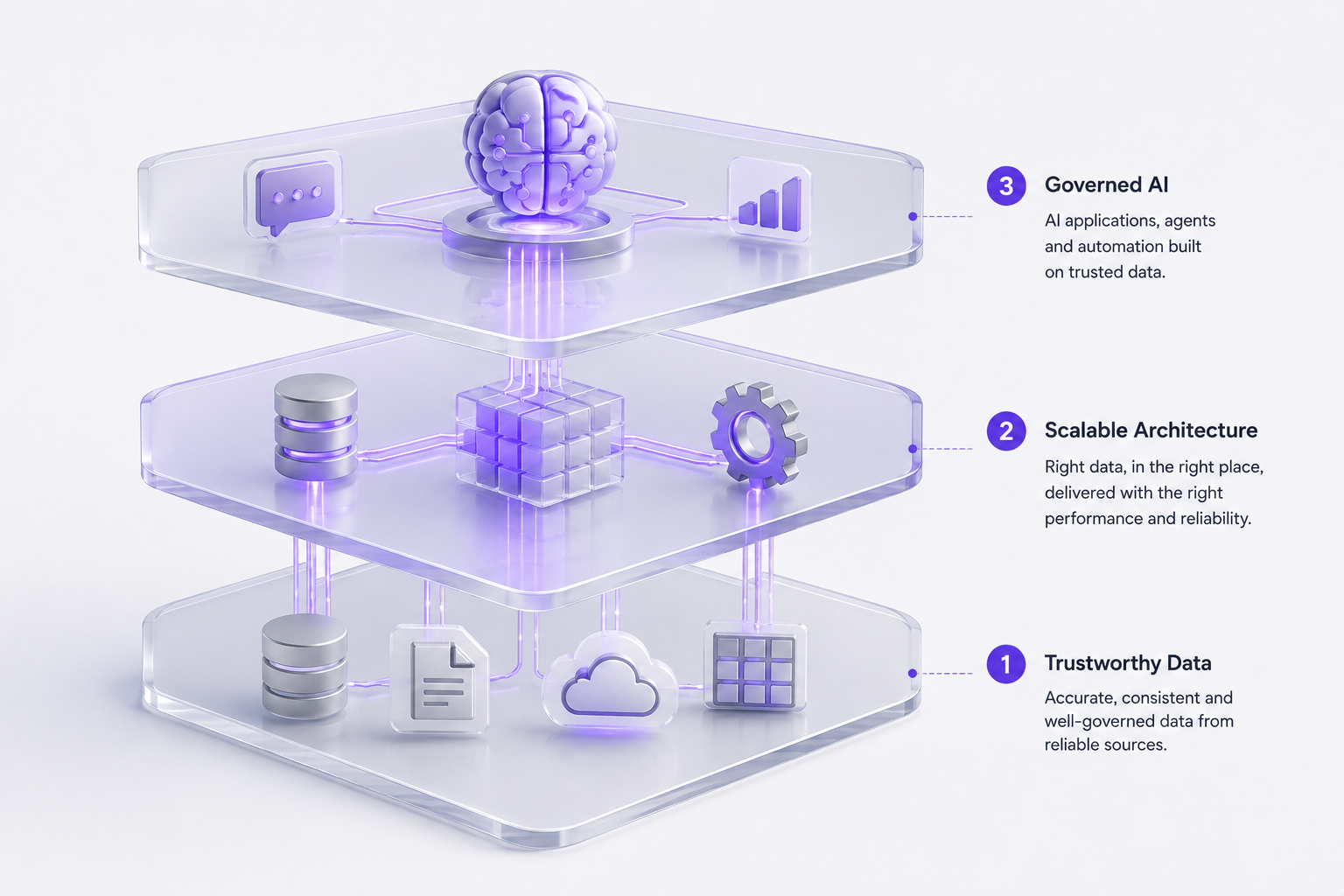
Trust in the numbers comes first
Before architecture, before models, a simpler question. Do people in your organization trust the numbers they already have? Often the answer is no, and AI makes that gap obvious fast.
1. The same KPI means different things to different teams
Ask three departments for last month’s revenue and you may get three figures. Finance counts invoiced sales net of VAT, sales counts booked orders, a dashboard reports a third number. For years this was survivable, because a person in the room knew which version to trust. An AI assistant has no such instinct. It quotes whichever definition it was pointed at. The first time a leader sees two contradictory answers, trust in the whole system is gone.
The fix is less technical than it sounds. Agree, once, on a single definition for each critical metric. Give it an owner. Treat any change as a deliberate, communicated decision, not a private edit. A shared language for your top KPIs lets AI settle an argument instead of starting one.
What we see in practice
Organizations often believe they have a data quality problem.
In reality, they have a consistency problem.
The data exists. The business simply disagrees on what it means.
2. Data is produced as reports, not as products
In many companies, data still arrives the old way. Someone asks a question, an analyst pulls an export, cleans it by hand, sends it on. The next question starts over. No single report is wrong, but none is reusable, and two analysts can answer the same question with two different numbers and no one accountable for the gap.
Treating data as a product changes how the organization relates to it. A critical dataset stops being prepared on demand and becomes a service: a named owner, defined quality and freshness, a clear definition, a plan to improve it. That is not process for its own sake. It is how an AI system relies on the same data tomorrow that it used today.
3. When data breaks, nobody finds out in time
Most data does not fail loudly. A feed lands late, a load runs half-empty, a field changes shape, and the dashboard shows a number as if nothing happened. In a reporting world, someone eventually catches it. In an AI world, the broken data is already inside an answer to a customer. Reporting forgives a late feed. AI does not.
The instinct is to monitor everything. Resist it. Start with the datasets that feed your first AI use cases, and watch the three failures that actually happen: data that arrives late, volumes that swing far from normal, structures that change without warning. Give each alert an owner and a simple response. Monitoring everything creates noise. Monitoring what your AI depends on creates trust. It is the daily reality behind why clean data matters.
Even with trustworthy data, the architecture gets in the way
Plenty of organizations fix their definitions and still stall. AI brings a workload their systems were never built for. BI explains what happened. AI increasingly decides what happens next, and it needs to know what is happening right now. That single shift exposes architectural limits most companies have never had to solve.
What we see in practice
Companies rarely rebuild their architecture because of AI.
More often, AI just exposes bottlenecks that were always there.
The architecture was never wrong. It was built for a different question.
4. Everything still runs through one monolithic warehouse
A warehouse is excellent for yesterday. AI increasingly cares about now. Built for batch processing, historical aggregates, and SQL analytics, a single warehouse strains the moment you ask it for low-latency, operational queries: storage priced for performance even on cold data, an awkward fit for events and unstructured content, and a change process so interconnected that one adjustment ripples through dozens of reports. Everything runs at one speed, and that speed is rarely now.
The answer is not another migration project. Different workloads have different requirements, and historical analytics should not compete with operational AI for the same architecture. Data has a temperature. Cold and hot history, analytics, and model training belong in a lakehouse; warm, current-state data belongs in a faster operational layer built for it. Separate the two and you stop paying to scale one expensive system for workloads that never belonged together.
5. AI has to reach into your core systems to know what is happening now
Enterprise AI earns its keep the moment it answers operational questions. A warehouse manager asks which orders are blocked by missing inventory. A claims adjuster asks which cases need manual review today. Finance asks whether an invoice has already been paid.
That is the moment many organizations discover their architecture was never designed to hand out operational data safely. The only way to answer is to query the ERP, the CRM, or SAP directly, which is slow, costly, and risky enough that most IT teams refuse. Rightly.
This is what an operational data store, an ODS, is for. It sits between the core systems and everything that consumes them, fed through your integration layer, holding only the current state that matters. It answers live questions fast, takes load off the systems the business runs on, and keeps a clean line between warm operational data and colder history in the lakehouse. Do not build it for everything. Pick three to five high-value questions and start there.
What we see in practice
The blocker is rarely technical.
No one has ever had to expose operational data outside the core system, so there is no safe path to do it.
The ODS is an organizational decision as much as an architectural one.
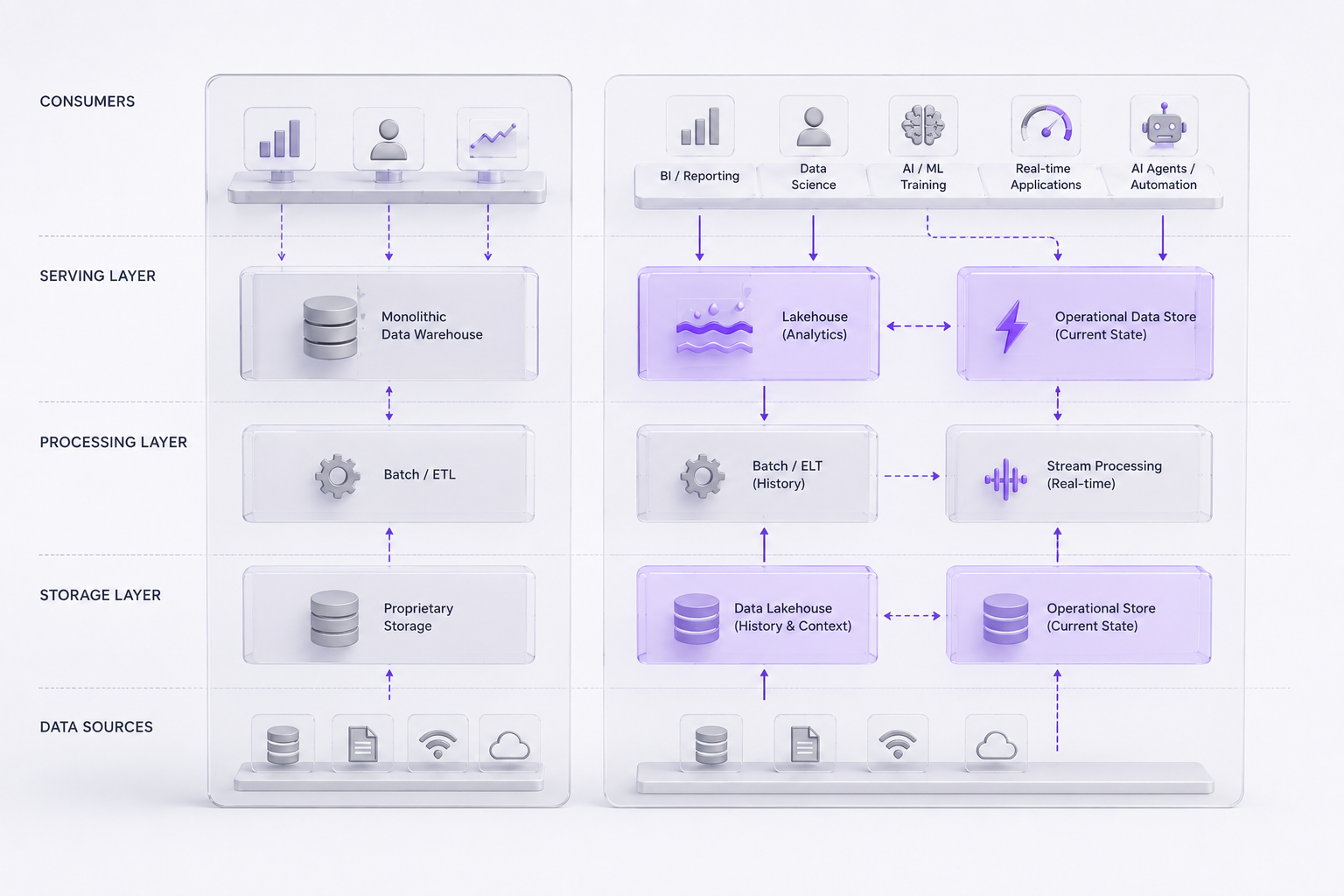
6. Real-time turns out to mean nothing in particular
Almost every enterprise says it has real-time data. Press a little, and the term dissolves. To one team it means a copy of the core systems within minutes; to another, an hourly stream aggregation; to a third, an event feed with a seconds-level guarantee. Often the real-time layer exists on paper, but events flow with no clear path, no validation, and no one watching whether they arrive. For AI the effect is small but expensive. The system reacts late, and a technically correct answer can already be wrong by the time it lands.
Start with a definition, not a technology. Once each use case has an agreed meaning of real-time, the minimum is unglamorous and reliable: a clear flow from source to consumer, basic validation, monitoring that confirms data arrived on time and in full, and an owner who reacts when it does not. You know it works when a delay is caught before it reaches a customer, not after.
7. The API was built for one app, and it shows
An API is often an accident of history, a by-product of the first web or mobile app that needed one. It works until you connect something new: an AI agent, a partner, another team. Then it shows its age. Brittle, unversioned, every change breaks another consumer, and onboarding anything new becomes a project. That friction is the real line between a pilot and scaling.
The shift is simple: stop treating the API as plumbing for one application and start treating it as a product. Stable. Versioned. Governed. Built around business capabilities rather than individual channels. Give AI a stable interface to current, well-defined data, and the workarounds and manual glue that sink so many AI projects stop appearing.
What we see in practice
AI projects rarely fail because an API is missing.
They fail because every API was built around a different application.
The fix is rarely more APIs. It is fewer, better ones.
Once AI touches your documents, discipline matters more than models
Structured data is only half the story. The most valuable enterprise AI increasingly works over documents: policies, contracts, procedures, product knowledge. Here the gap between a demo and a dependable system is almost entirely about discipline.
8. AI answers from your documents, but no one can say which one
An assistant gives a confident, fluent answer about an HR policy or a contract clause. It sounds right. But nobody can tell which document it used, or whether that document is still valid. In our experience the real risk is almost never the model. It is the underlying content: outdated files, no clear source of truth, no owner. An AI system will give a correct answer from the wrong document, and trust drains fast when it does.
Safe AI over company knowledge comes down to a few principles: draw only from approved sources, give each source an owner, respect the reader’s access rights, keep to the current version, and cite the passages behind every answer. Technically, that is retrieval-grounded generation: approved documents live in a document store with a vector index, the system retrieves the most relevant passages, and every answer carries its evidence. It is the same discipline as good enterprise search. It turns a plausible answer into a defensible one.
What we see in practice
The hardest part of document AI is rarely the retrieval.
It is discovering how much of the source of truth is outdated, duplicated, or owned by no one.
AI does not create that problem. It just makes it impossible to ignore.
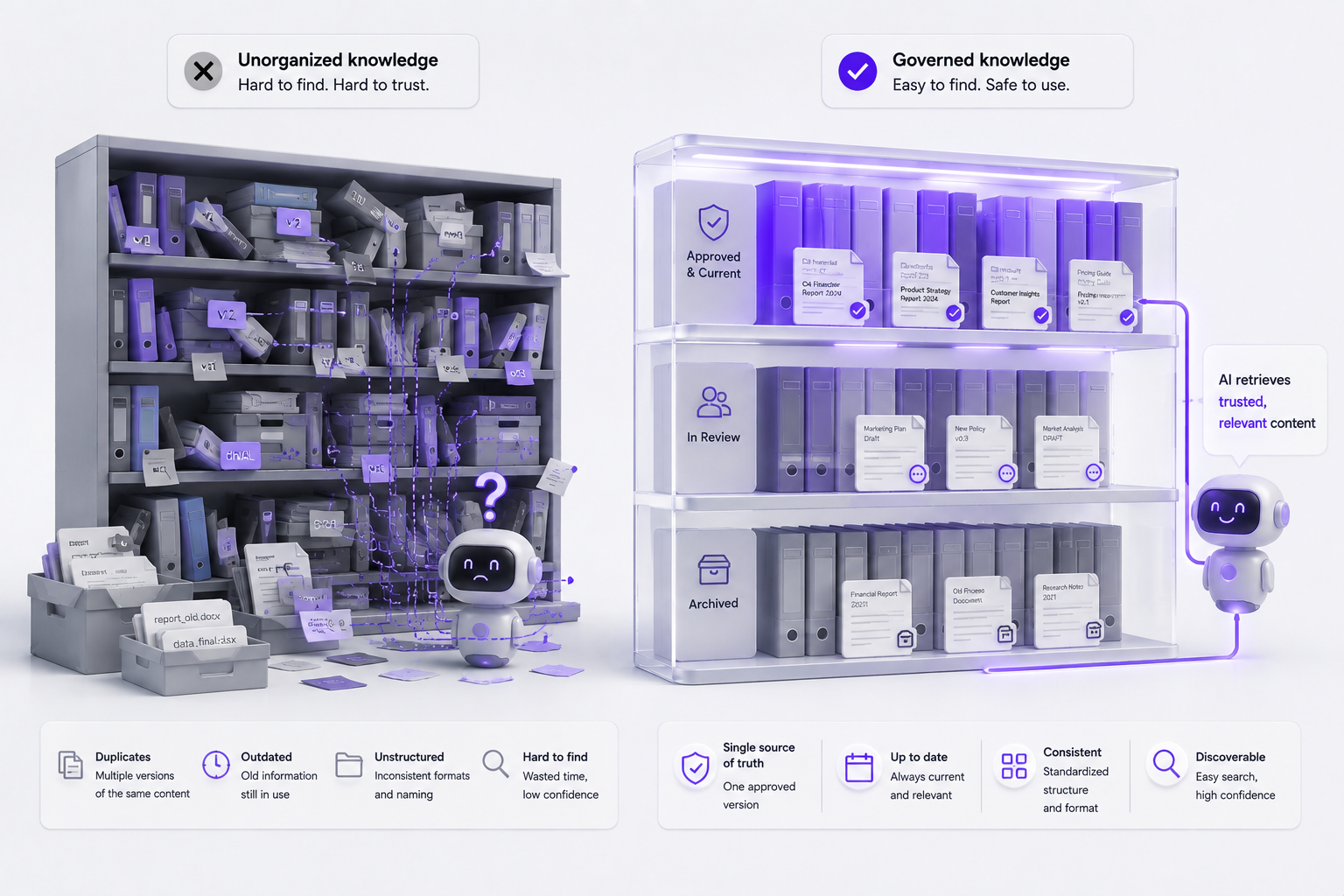
9. Nobody actually knows if the AI’s answers are any good
Ask most teams how their AI is performing and you get an impression, not a measurement. That is how a system slips: the off-topic answer, the one with no source, the one that leaks something sensitive, unnoticed until a customer or auditor notices first. It seems fine is not a control.
Measuring quality is simpler than it looks. Assemble twenty to fifty real questions from actual use, and score each answer on three things: is it relevant, is it grounded in a source, is it within the user’s permissions. Re-run the set whenever you change the sources or the process. Watch a few production signals too: how often the AI escalates to a human, how often it finds no answer, how many answers carry citations. The goal is not a perfect score. It is a decision you can defend, scale this, adjust this, or stop this, made on evidence rather than instinct.
10. The AI belongs to everyone, and therefore to no one
The last sign decides whether the others get solved. When an AI use case has no owner and every scenario gets the same reflex, you land in one of two failure modes: too cautious to ship, or too casual to be safe. The same assistant can be harmless summarizing an internal FAQ and real trouble drafting something a customer acts on. Most organizations treat both the same.
Governance, done well, is not bureaucracy. It is what lets AI scale without fear. The practical version is modest: give every use case an owner, classify it by risk, match the controls to the risk. Low-risk uses run automatically with a record of what happened. Higher-risk ones earn a human check, restricted sources, and an escalation path. Under that sit five basics: an owner, approved sources, access rules, an audit trail, an incident process. There is now a regulatory reason to have them, with EU AI Act penalties reaching up to 7 percent of global annual turnover. The point is not to slow AI down. It is to make it defensible enough to speed up.

How Our AI System Fights Against Frauds in International Shipping
BigHub has a longstanding partnership with a major international logistics firm, during which it has successfully implemented a diverse range of data projects. These projects have encompassed a variety of areas, including data engineering, real-time data processing, cloud and machine learning-based applications, all of which have been designed and developed to enhance the logistics company's operations, including warehouse management, supply chain optimization and the transportation of thousands of packages globally on a daily basis.
In 2022, BigHub was presented with a new challenge: to aid in the implementation of a system for the early detection of suspicious fraudulent shipments entering the company's logistic network. Based on the client's pilot solution, which had been developed and tested using historical data, BigHub improved the algorithms and deployed them in a production environment for real-time evaluation of shipments as they entered the transportation network. The initial pilot solution was based on batch evaluation, but the requirement for our team was to create a REST API that could handle individual queries with a response time of less than 200 milliseconds. This API would be connected to the client's network, where further operations would be carried out on the data.
.avif)
The proposed application is designed with a high-level architecture, as illustrated in the accompanying diagram. The core of the system is the REST API, which is connected to the client's network to receive and process queries. These queries are subject to validation and evaluation, with the results then returned to the end user. The data layer serves as the foundation for the calculations, as well as for the training of models and pre-processing of feature tables. The evaluation results are also stored in the data layer to facilitate the production of summary analyses in the reporting layer. The MLOps layer manages the lifecycle of the machine learning model, including training, validation, storage of metrics for each model version and making the current version of the model accessible via the REST API. To achieve this, the whole solution leverages a variety of modern data technologies, including Kubernetes, MLFlow, AirFlow, Teradata, Redis and Tableau.
During the development of the system our team needed to address several challenges that include:
- Setup and scaling of the REST API to handle a high volume of queries (260 queries from 30 parallel resources per second) in real-time, ensuring it is ready for global deployment.
- Optimizing the evaluation speed of individual queries, through the use of low-level programming techniques, to reduce the time from hundreds of milliseconds to tens of milliseconds.
- Managing the machine learning model lifecycle, including automated retraining, deployment of new versions into API, monitoring of quality and notifications, to ensure reliable long-term performance.
- Implementing modifications on the run - our agile approach ensured flexibility and allowed quick and successful changes to the ongoing project for the satisfaction of both parties and better results.

BigHub is a proud DATA mesh partner
An informal regular meetup full of latest data gossip where you can attend talks from anybody who loves data - from legendary startup founders to junior data enthusiasts. We’re talking about the DATA Mesh meetup, of which we are a partner.
"We were looking for a place where we could meet informally to discuss and share experience from interesting projects with each other. That's why we decided to do regular data meetups," says Karel Šimánek, CEO of BigHub and one of the organizers and founders of DATA Mesh.

The meetup is held every month at the K7 club in Prague's Vršovice and visitors can enjoy short but inspiring presentations from various fields with people who have real experience with data and ML applications. Of course, there is also an afterparty, where you can make great contacts, and play the legendary Atomic Bomberman game for awesome prizes.

In total, there have been five meetups already with guests like Sara Polak, Jan Kučera from Datamole, Lukáš Jelínek from Pocket Virtuality or Jan Šindera from Nano energies.

BigHub scored in the Deloitte Technology Fast 50 CE 2021 competition
Tenth in Central Europe and sixth in the Czech Republic. These are the results of the Deloitte Technology Fast 50 CE 2021 competition, which compares the growth of registered technology companies over the previous four years, from 2017 to 2020. This year, 19 companies from the Czech Republic made it to the CE Top 50, top ten winners included FTMO, DoDo, Driveto, or DataSentics, and our BigHub! was one of them. We are very grateful to be ranked among such great companies.
With an overall growth of 1 795%, we close the top ten companies in CE. In addition, 139 local companies applied this year so it was possible to compile a ranking of 50 top Czech technology companies, where we ended up in sixth place. ”The experience from previous years shows that thanks to the Fast 50 programme, companies manage to find interesting opportunities, change their ways and keep growing,” says Jiří Sauer, CE Technology Fast 50 Programme Leader.

The dominance of the Czech tech scene was impossible to overlook. We have 6 representatives in the European top 10 and 19 domestic tech leaders in the European top 50. At the same time, this year's edition also recorded the highest growth figures, with the average number of companies registered growing by 2 278%.
The ceremony took place in the Archa Theatre and the evening was hosted by moderator Tomáš Studeník. All Czech and Central European companies that were awarded in the Deloitte Technology Fast 50 program, you can find on this page.

BigHub wins Readers' Choice Award for the best business story in the EY Entrepreneur of the Year competition
Tomáš Hubínek and Karel Šimánek founded BigHub, a technology company that specializes in applied AI. Their skillset and technology stack has multiple applications, from predicting employee turnover and detecting electricity theft.
They met while studying at the Czech Technical University in Prague. Both of them were working in consulting and banking firms before realizing the untapped potential of AI in business. It all led to the founding of BigHub in 2016, which has been profitable since its inception and is on track to reach a turnover of CZK 100 million.
Their story has garnered attention and recognition from readers of Mladé fronta and Idnes.cz. The readers awarded BigHub with the Readers' Choice Award for the Best Business Story in the EY Podnikatel roku competition, a globally renowned competition for entrepreneurs founded by EY in 1986.
Detection and Prediction by BigHub
BigHub's work spans a variety of industries, including energy, logistics, retail and human resources. BigHub's neural network technology helps detect unwanted vibrations in the turbines of the Temelin nuclear power plant and predicts equipment failures at fueling stations, or has been involved in the development and implementation of an early detection system for identifying fraudulent shipments entering the logistics network.
"This year's winners are already showing us the environment in which the human species will exist shortly. And they also represent the future of high-end IT businesses, where the Czechs have traditionally asserted themselves in the strongest global competition. I believe that such success awaits BigHub Tomáš Hubínek and Karel Šimánek as well, and I congratulate both gentlemen on their victory," said Jaroslav Plesl, Editor-in-Chief of MF DNES, to the winners of the Readers' Choice Award.
Another area where BigHub would like to help is healthcare, where artificial intelligence can be of help. "I like projects that have an impact and medicine is an area where AI can be very useful," admits Hubínek.

Constant monitoring of AI trends
In addition to their work at BigHub, Tomáš and Karel are actively involved in various initiatives to support and promote the development of AI technology and talented students. They are both lecturers at the Czech Technical University in Prague and high schools and are dedicated to staying up-to-date with the latest AI trends.
They also organize regular meetups for industry professionals across companies to network and share their expertise and participate in a data podcast, which provides insightful interviews on expert topics from the Czech and Slovak data scene. Furthermore, they support the Josef Hlávka Prize, which recognizes and rewards talented students.

Get your first consultation free
Want to discuss the details with us? Fill out the short form below. We’ll get in touch shortly to schedule your free, no-obligation consultation.