Migrate your data platform — without rewriting it line by line
BigHub deploys a multi-agent system that reverse-engineers your legacy platform, rebuilds it on a modern stack, and validates every table, transformation, and dependency automatically. What used to take months now runs in weeks.



Why manual migrations break down
Legacy platforms were built over decades by people who have since left. Migrating them by hand means rediscovering that logic object by object, then hoping the rewrite behaves the same in production.

Months of manual reverse engineering

Translations that drift from the source

No systematic validation
Vendor lock-in persists
The cost of staying on your legacy platform
Every quarter you delay migration, the bill grows — in license fees, lost talent, mounting technical debt, and missed opportunities. Here's what staying put actually costs.

Rising license costs

Shrinking talent pool

Growing technical debt

Blocked innovation

How agentic migration works
A multi-agent system handles discovery, translation, validation, and optimization — with minimal human intervention.
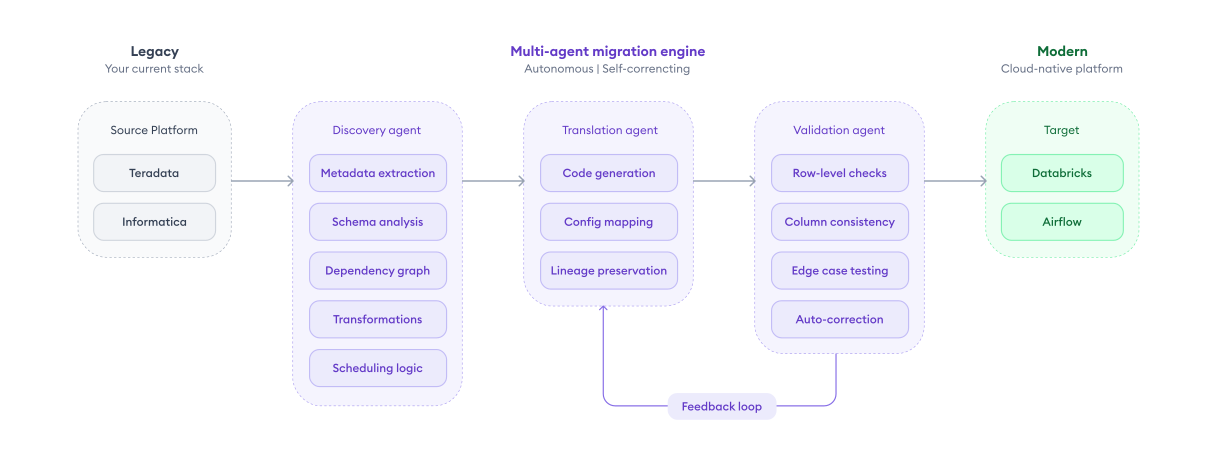
Discovery agent
Connects to the source platform and extracts the full metadata graph: objects, schemas, transformations, scheduling logic, and inter-system dependencies. No manual documentation required.
Translation agent
Based on the target platform's architecture and syntax (e.g. Databricks, Airflow), agents generate the equivalent code, configuration, and orchestration. Every translation preserves original business logic and data lineage.
Validation agent
Compares source and target end to end — row counts, column-level consistency, transformation outputs, edge cases. Discrepancies are flagged and autonomously corrected.
Optimization & handoff
Once validated, agents optimize the target solution for performance and cost. BigHub delivers the migrated environment with full documentation, lineage mapping, and handoff to your team.
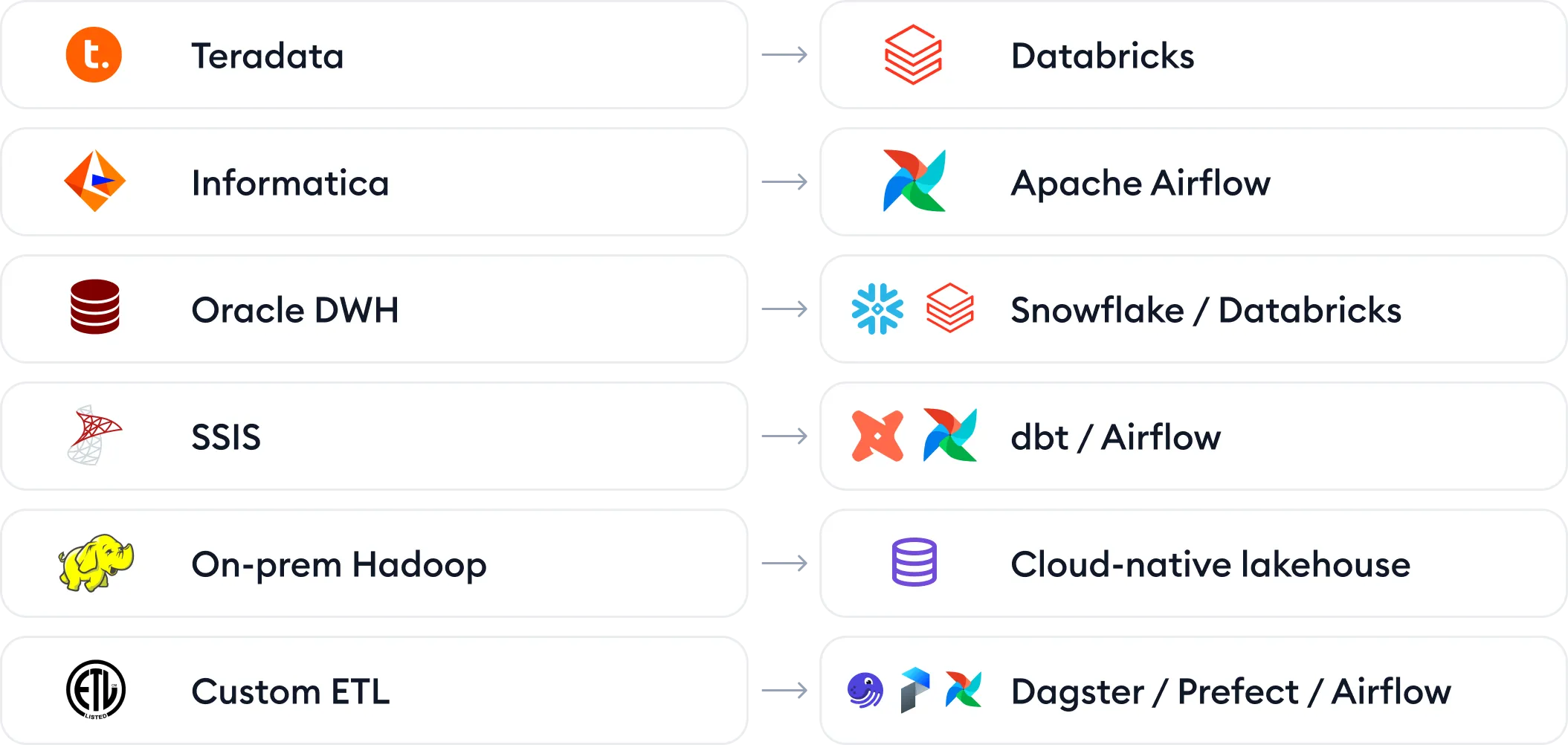
Common migration paths
Not sure about your stack? We assess any source platform.
Everything migrates. Not just the tables.
Agentic migration covers your entire data stack — not just SQL objects, but the full ecosystem of logic, orchestration, security, and documentation that makes it work.
Tables & schemas
Full DDL translation with data types, constraints, partitioning, and indexes.
Views & materialised views
Complex view logic translated and optimised for the target engine.
Stored procedures & functions
Business logic in SQL, PL/SQL, or proprietary syntax — fully converted.
ETL / ELT pipelines
Informatica mappings, SSIS packages, custom scripts → Airflow, dbt, Dagster.
Scheduling & orchestration
Job schedules, dependencies, triggers, retry logic — rebuilt natively.
Security model
Users, roles, permissions, row-level security — mapped to target IAM.
Data lineage
Full source-to-target lineage preserved and documented for governance.
Tests & data quality rules
Existing checks migrated + new validation layer added automatically.
Documentation
Auto-generated documentation for every migrated object, transformation, and dependency.
What sets this apart
The difference is not that AI helps with the migration. It is that the system finishes it, checks its own work against the source, and leaves behind an audit trail you can hand to compliance.

Autonomous, not assisted
Built-in validation loop

Full lineage & traceability

Proven in enterprise
Months become weeks
Manual migration projects routinely overshoot timelines and budgets. Agentic migration compresses the cycle by automating the most labour-intensive phases.
Traditional manual migration
Agentic migration (BigHub)
Enterprise-grade security at every step
Migration agents operate within your security perimeter and comply with your governance policies. No data leaves your environment without your explicit approval.

Data residency & isolation

Full audit trail

Role-based access control

Compliance-ready
Frequently asked
Everything you need to know about the product and billing. Can’t find the answer you’re looking for? Please chat to our friendly team.
There's no strict minimum, but agentic migration delivers the most value for environments with 100+ objects (tables, views, procedures, ETL jobs). For smaller scopes, a lighter approach may be more appropriate — we'll assess this during discovery.
On the source side, typically Oracle, Teradata, MS SQL Server, DB2, SAP BW, Informatica, SSIS, DataStage and on-premise Hadoop or Hive estates. On the target side, Databricks, Microsoft Fabric, Snowflake, Azure Synapse, BigQuery and Redshift. The agent system is not a fixed connector catalogue: it is built for your specific source-target pair, so an unusual or in-house legacy platform is still in scope.
No. The migration itself works on metadata and code: DDL, stored procedures, ETL definitions, scheduler configuration and lineage. Production data is needed only for validation, and that step runs inside your environment, on your infrastructure, with no data leaving your perimeter. For regulated environments we can deploy the agent system fully internally, including air-gapped, with role-based access control and a complete audit trail.
Fixed price per phase, not open-ended time and materials. It starts with a paid assessment at a fixed fee, which produces the object inventory, the complexity profile and a firm quote for the migration itself. Because the agent system's throughput is predictable, we can commit to a fixed price where the market standard is a day-rate estimate that grows over the project.
For a mid-sized platform, typically 9 to 17 weeks end to end, against 6 to 12 months for the same scope done manually. The assessment takes one to two weeks, conversion and validation run in parallel rather than in sequence, and the cutover window itself is the part that depends on your release calendar, not on us. Exact ranges come out of the assessment.
A hypercare period of typically four to eight weeks follows the cutover, during which we monitor the new platform, resolve findings and hand over operations to your team. After that you can take it in-house or keep us on a managed-run retainer. Either way the migrated codebase, the generated documentation and the full lineage map are yours, with no dependency on BigHub to keep the platform running.
Yes, and we recommend it. A pilot covers one representative subject area, usually a few dozen objects, at a fixed price over three to four weeks, with a pass criterion agreed before we start: validated parity between the migrated objects and the source. You see the real output, the validation evidence and the actual conversion rate on your own estate before anyone signs a full-scope contract.
Ready to move off your legacy platform?
Want to discuss the details with us? Fill out the short form below. We’ll get in touch shortly to schedule your free, no-obligation consultation.