BigHub Blog - Read, Discover, Get inspired.
The latest industry news, interviews, technologies, and resources.

10 signs your data isn't ready for AI (and how to fix each)
The organizations getting the most from AI are not the ones with better models. They are the ones with better data foundations.
It is worth being honest about how far the model has slid down the list of things that matter. The latest language and embedding models are available to everyone at roughly the same quality, and standing up an impressive demo takes days. The demo is easy. The system behind it is not. What separates a proof of concept from something an enterprise can trust is almost never the model. It is whether the data underneath it can be used again and again, safely and consistently.
Across more than 500 projects with over 100 enterprise clients since 2016, the same warning signs come up again and again. They fall into three groups: whether the data itself can be trusted, whether the architecture can serve it, and whether AI can work safely on your knowledge. Here are the ten that matter most, and what to actually do about each.
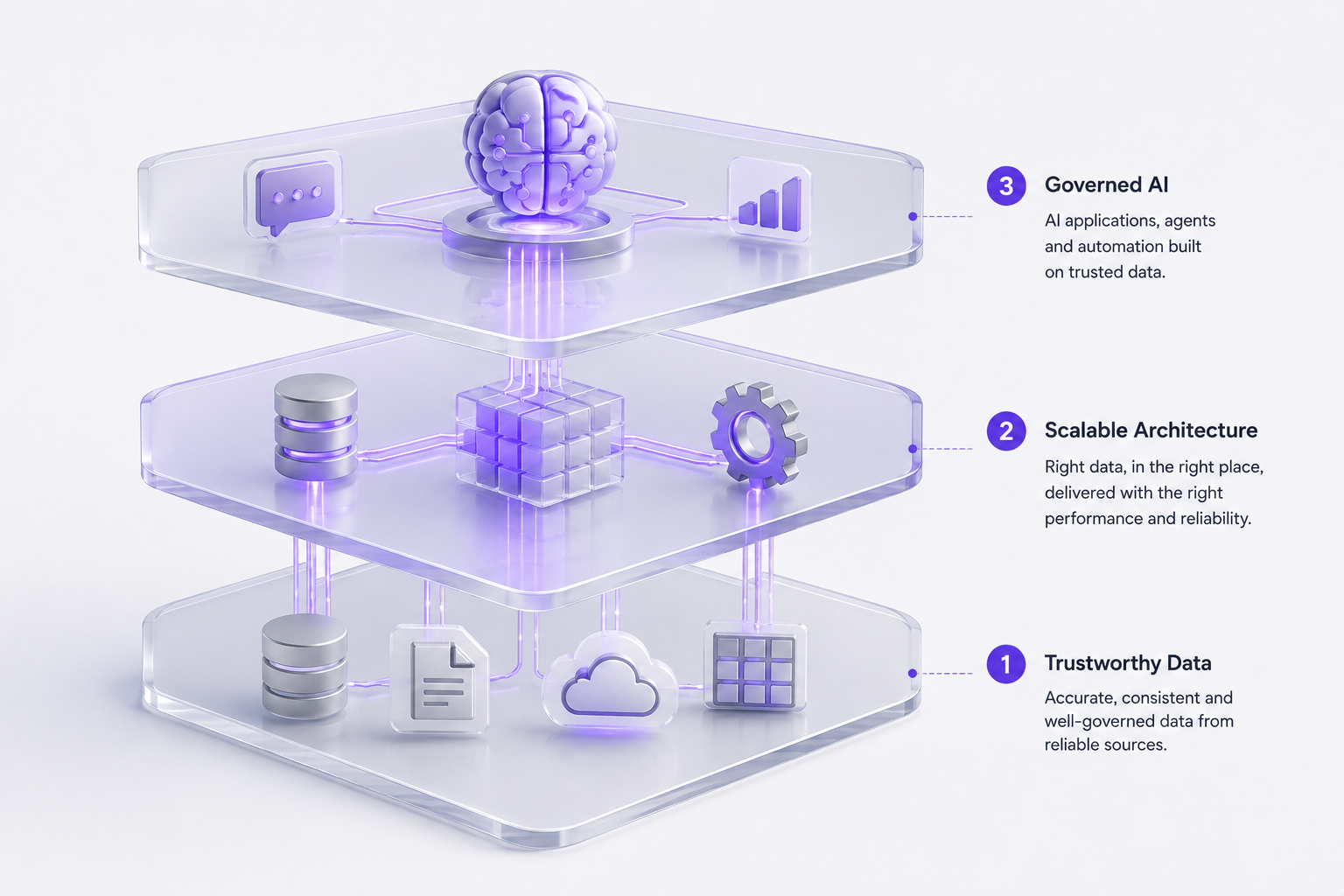
Trust in the numbers comes first
Before architecture, before models, a simpler question. Do people in your organization trust the numbers they already have? Often the answer is no, and AI makes that gap obvious fast.
1. The same KPI means different things to different teams
Ask three departments for last month’s revenue and you may get three figures. Finance counts invoiced sales net of VAT, sales counts booked orders, a dashboard reports a third number. For years this was survivable, because a person in the room knew which version to trust. An AI assistant has no such instinct. It quotes whichever definition it was pointed at. The first time a leader sees two contradictory answers, trust in the whole system is gone.
The fix is less technical than it sounds. Agree, once, on a single definition for each critical metric. Give it an owner. Treat any change as a deliberate, communicated decision, not a private edit. A shared language for your top KPIs lets AI settle an argument instead of starting one.
What we see in practice
Organizations often believe they have a data quality problem.
In reality, they have a consistency problem.
The data exists. The business simply disagrees on what it means.
2. Data is produced as reports, not as products
In many companies, data still arrives the old way. Someone asks a question, an analyst pulls an export, cleans it by hand, sends it on. The next question starts over. No single report is wrong, but none is reusable, and two analysts can answer the same question with two different numbers and no one accountable for the gap.
Treating data as a product changes how the organization relates to it. A critical dataset stops being prepared on demand and becomes a service: a named owner, defined quality and freshness, a clear definition, a plan to improve it. That is not process for its own sake. It is how an AI system relies on the same data tomorrow that it used today.
3. When data breaks, nobody finds out in time
Most data does not fail loudly. A feed lands late, a load runs half-empty, a field changes shape, and the dashboard shows a number as if nothing happened. In a reporting world, someone eventually catches it. In an AI world, the broken data is already inside an answer to a customer. Reporting forgives a late feed. AI does not.
The instinct is to monitor everything. Resist it. Start with the datasets that feed your first AI use cases, and watch the three failures that actually happen: data that arrives late, volumes that swing far from normal, structures that change without warning. Give each alert an owner and a simple response. Monitoring everything creates noise. Monitoring what your AI depends on creates trust. It is the daily reality behind why clean data matters.
Even with trustworthy data, the architecture gets in the way
Plenty of organizations fix their definitions and still stall. AI brings a workload their systems were never built for. BI explains what happened. AI increasingly decides what happens next, and it needs to know what is happening right now. That single shift exposes architectural limits most companies have never had to solve.
What we see in practice
Companies rarely rebuild their architecture because of AI.
More often, AI just exposes bottlenecks that were always there.
The architecture was never wrong. It was built for a different question.
4. Everything still runs through one monolithic warehouse
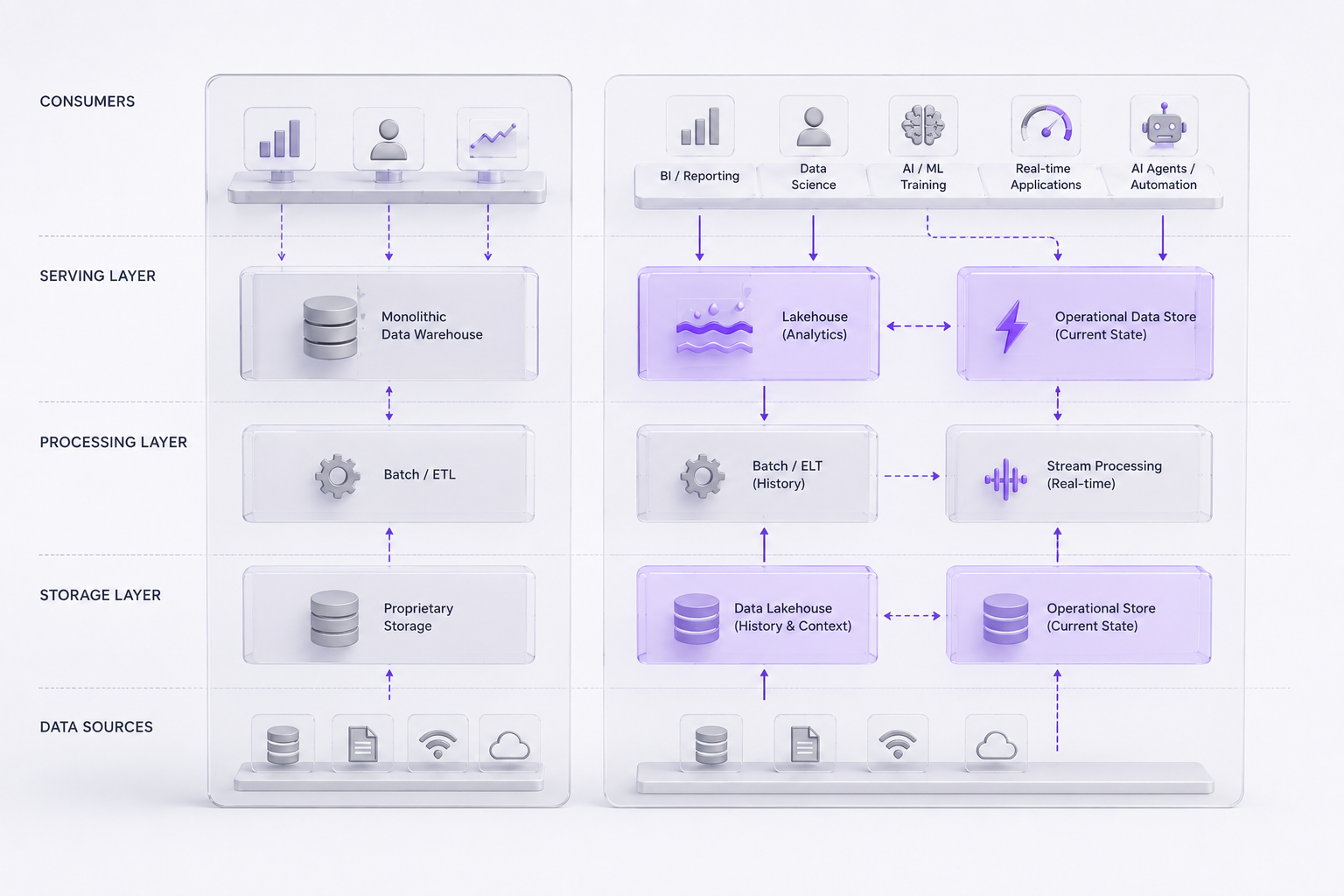
A warehouse is excellent for yesterday. AI increasingly cares about now. Built for batch processing, historical aggregates, and SQL analytics, a single warehouse strains the moment you ask it for low-latency, operational queries: storage priced for performance even on cold data, an awkward fit for events and unstructured content, and a change process so interconnected that one adjustment ripples through dozens of reports. Everything runs at one speed, and that speed is rarely now.
The answer is not another migration project. Different workloads have different requirements, and historical analytics should not compete with operational AI for the same architecture. Data has a temperature. Cold and hot history, analytics, and model training belong in a lakehouse; warm, current-state data belongs in a faster operational layer built for it. Separate the two and you stop paying to scale one expensive system for workloads that never belonged together.
5. AI has to reach into your core systems to know what is happening now
Enterprise AI earns its keep the moment it answers operational questions. A warehouse manager asks which orders are blocked by missing inventory. A claims adjuster asks which cases need manual review today. Finance asks whether an invoice has already been paid.
That is the moment many organizations discover their architecture was never designed to hand out operational data safely. The only way to answer is to query the ERP, the CRM, or SAP directly, which is slow, costly, and risky enough that most IT teams refuse. Rightly.
This is what an operational data store, an ODS, is for. It sits between the core systems and everything that consumes them, fed through your integration layer, holding only the current state that matters. It answers live questions fast, takes load off the systems the business runs on, and keeps a clean line between warm operational data and colder history in the lakehouse. Do not build it for everything. Pick three to five high-value questions and start there.
What we see in practice
The blocker is rarely technical.
No one has ever had to expose operational data outside the core system, so there is no safe path to do it.
The ODS is an organizational decision as much as an architectural one.
6. Real-time turns out to mean nothing in particular
Almost every enterprise says it has real-time data. Press a little, and the term dissolves. To one team it means a copy of the core systems within minutes; to another, an hourly stream aggregation; to a third, an event feed with a seconds-level guarantee. Often the real-time layer exists on paper, but events flow with no clear path, no validation, and no one watching whether they arrive. For AI the effect is small but expensive. The system reacts late, and a technically correct answer can already be wrong by the time it lands.
Start with a definition, not a technology. Once each use case has an agreed meaning of real-time, the minimum is unglamorous and reliable: a clear flow from source to consumer, basic validation, monitoring that confirms data arrived on time and in full, and an owner who reacts when it does not. You know it works when a delay is caught before it reaches a customer, not after.
7. The API was built for one app, and it shows
An API is often an accident of history, a by-product of the first web or mobile app that needed one. It works until you connect something new: an AI agent, a partner, another team. Then it shows its age. Brittle, unversioned, every change breaks another consumer, and onboarding anything new becomes a project. That friction is the real line between a pilot and scaling.
The shift is simple: stop treating the API as plumbing for one application and start treating it as a product. Stable. Versioned. Governed. Built around business capabilities rather than individual channels. Give AI a stable interface to current, well-defined data, and the workarounds and manual glue that sink so many AI projects stop appearing.
What we see in practice
AI projects rarely fail because an API is missing.
They fail because every API was built around a different application.
The fix is rarely more APIs. It is fewer, better ones.
Once AI touches your documents, discipline matters more than models
Structured data is only half the story. The most valuable enterprise AI increasingly works over documents: policies, contracts, procedures, product knowledge. Here the gap between a demo and a dependable system is almost entirely about discipline.
8. AI answers from your documents, but no one can say which one
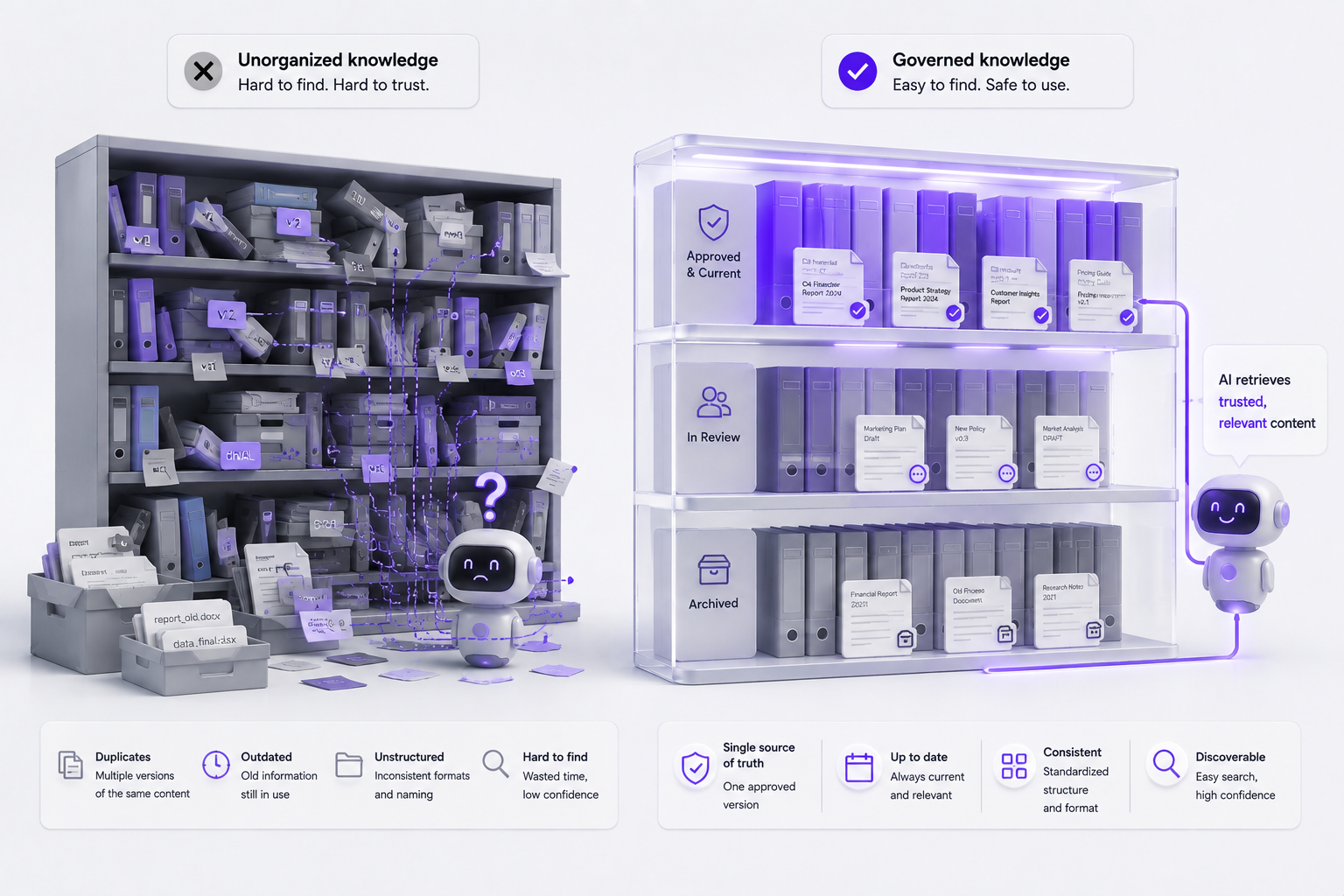
An assistant gives a confident, fluent answer about an HR policy or a contract clause. It sounds right. But nobody can tell which document it used, or whether that document is still valid. In our experience the real risk is almost never the model. It is the underlying content: outdated files, no clear source of truth, no owner. An AI system will give a correct answer from the wrong document, and trust drains fast when it does.
Safe AI over company knowledge comes down to a few principles: draw only from approved sources, give each source an owner, respect the reader’s access rights, keep to the current version, and cite the passages behind every answer. Technically, that is retrieval-grounded generation: approved documents live in a document store with a vector index, the system retrieves the most relevant passages, and every answer carries its evidence. It is the same discipline as good enterprise search. It turns a plausible answer into a defensible one.
What we see in practice
The hardest part of document AI is rarely the retrieval.
It is discovering how much of the source of truth is outdated, duplicated, or owned by no one.
AI does not create that problem. It just makes it impossible to ignore.
9. Nobody actually knows if the AI’s answers are any good
Ask most teams how their AI is performing and you get an impression, not a measurement. That is how a system slips: the off-topic answer, the one with no source, the one that leaks something sensitive, unnoticed until a customer or auditor notices first. It seems fine is not a control.
Measuring quality is simpler than it looks. Assemble twenty to fifty real questions from actual use, and score each answer on three things: is it relevant, is it grounded in a source, is it within the user’s permissions. Re-run the set whenever you change the sources or the process. Watch a few production signals too: how often the AI escalates to a human, how often it finds no answer, how many answers carry citations. The goal is not a perfect score. It is a decision you can defend, scale this, adjust this, or stop this, made on evidence rather than instinct.
10. The AI belongs to everyone, and therefore to no one
The last sign decides whether the others get solved. When an AI use case has no owner and every scenario gets the same reflex, you land in one of two failure modes: too cautious to ship, or too casual to be safe. The same assistant can be harmless summarizing an internal FAQ and real trouble drafting something a customer acts on. Most organizations treat both the same.
Governance, done well, is not bureaucracy. It is what lets AI scale without fear. The practical version is modest: give every use case an owner, classify it by risk, match the controls to the risk. Low-risk uses run automatically with a record of what happened. Higher-risk ones earn a human check, restricted sources, and an escalation path. Under that sit five basics: an owner, approved sources, access rules, an audit trail, an incident process. There is now a regulatory reason to have them, with EU AI Act penalties reaching up to 7 percent of global annual turnover. The point is not to slow AI down. It is to make it defensible enough to speed up.

AI Agents: What they are and what they mean for your business
🧠 What Are AI Agents?
An AI agent is a digital assistant capable of independently executing complex tasks based on a specific goal. It’s more than just a chatbot answering questions. Modern AI agents can:
- Plan multiple steps ahead
- Call APIs, work with data, create content, or search for information
- Adapt their behavior based on context, user, or business goals
- Work asynchronously and handle multiple tasks simultaneously
In short, an AI agent functions like a virtual employee — handling tasks dynamically, like a human, but faster, cheaper, and 24/7.
Why Are AI Agents Trending Right Now?
- Advancements in large language models (LLMs) like GPT-4, Claude, and Mistral allow agents to better understand and generate natural language.
- Automation is becoming goal-driven — instead of saying “write a script,” you can say “find the best candidates for this job.”
- Companies want to scale without increasing costs — AI agents can handle both routine and analytical tasks.
- Productivity and personalization are top priorities — AI agents enable both in real time.
What Do AI Agents Bring to Businesses?
✅ 1. Save Time and Costs
Unlike traditional automation focused on isolated tasks, AI agents can manage entire workflows. In e-commerce, for example, they can:
- Help choose the right product
- Recommend accessories
- Add items to the cart
- Handle complaints or returns
✅ 2. Boost Conversions and Loyalty
AI agents personalize conversations, learn from interactions, and respond more precisely to customer needs.
✅ 3. Team Relief and Scalability
Instead of manually handling inquiries or data, the agent works nonstop — error-free and without the need to hire more people.
✅ 4. Smarter Decision-Making
Internal agents can assist with competitive analysis, report generation, content creation, or demand forecasting.
AI Agents in Practice
AI Agent vs. Traditional Chatbot: What's the Difference?
What Does This Mean for Your Business?
Companies that implement AI agents today gain an edge — not just in efficiency, but in customer experience. In a world where “fast replies” are no longer enough, AI agents bring context, intelligence, and action — exactly what the modern customer expects.
What’s Next?
AI agents are quickly evolving from assistants to full digital colleagues. Soon, it won’t be unusual to have an “AI teammate” handling tasks, collaborating with your team, and helping your business grow.

GenAI Is not the only type of AI: What every business leader should know
🧠 What Is Generative AI (GenAI)?
Generative AI focuses on creating content — text, images, video, or code — by using large language models (LLMs) trained on huge datasets.
Typical use cases:
- Writing emails, articles, product descriptions
- Generating graphics and images
- Creating code or marketing copy
- Customer support via AI-powered chat
But despite its capabilities, GenAI isn't a one-size-fits-all solution.
What Other Types of AI Exist?
✅ 1. Analytical AI
This type of AI focuses on analyzing data, identifying patterns, and making predictions. It doesn't generate content but provides insights and decisions based on logic and data.
Use cases:
- Predicting customer churn or lifetime value
- Credit risk scoring
- Fraud detection
- Customer segmentation
✅ 2. Optimization AI
Rather than analyzing or generating, this AI finds the best possible solution based on a defined goal or constraint.
Use cases:
- Logistics and transportation planning
- Dynamic pricing
- Manufacturing and workforce scheduling
✅ 3. Symbolic AI (Rule-Based Systems)
This older but still relevant form of AI uses logic-based rules and decision trees. It is explainable, auditable, and reliable — especially in regulated environments.
Use cases:
- Legal or medical expert systems
- Regulatory compliance
- Automated decision-making in banking or insurance
✅ 4. Reinforcement Learning
This AI learns by trial and error in dynamic environments. It’s used when the system needs to adapt based on feedback and outcomes.
Use cases:
- Autonomous vehicles
- Robotics
- Complex process automation
When Should (or Shouldn’t) You Use GenAI?
What Does This Mean for Your Business?
If you're only using GenAI, you might be missing out on significant potential. The real value lies in combining AI types.
Example:
- Use Analytical AI to segment your customers.
- Use GenAI to generate personalized emails for each segment.
- Use Optimization AI to time and target campaigns efficiently.
This multi-layered approach delivers better ROI, reliability, and strategic depth.
Summary: GenAI ≠ All of AI

Why clean data matters (and what It actually means to “have data in order”)
🧠 What does it mean to have your data in order?
It’s more than storing files in the cloud or keeping spreadsheets neat.
When your data is “in order,” it means that:
- It’s accessible – people across the company can access it easily and securely
- It’s high-quality – data is clean, up to date, and consistent
- It has context – you know where the data came from, how it was created, and what it represents
- It’s connected – systems talk to each other, there are no data silos
- It’s actionable – the data supports decision-making, automation, and business goals
In short: Clean data = trustworthy and usable data.
How can you tell if your data isn’t in order?
Here are some common red flags:
These challenges are common—startups, scale-ups, and enterprises all face them at some point.
What are the risks of messy or low-quality data?
Slower decisions
Without confidence in your data, decisions are delayed—or based on gut feeling instead of facts.
Wasted resources
Analysts spend most of their time cleaning and merging data, rather than generating value.
Poor customer experiences
Outdated or fragmented data means poor personalization, errors in communication, or missed opportunities.
Blocked AI and automation efforts
You can’t build predictive models or automation without structured, clean data.
What does it take to “clean up your data”?
Data audit
Map out your data sources, flows, and responsibilities.
Data integration
Connect systems like CRM, ERP, e‑shop, marketing platforms into a unified view.
Implement a modern data platform
Build a central, scalable place to store and manage data (e.g., a data warehouse with BI tools).
Ensure data quality
Remove duplicates, validate formats, ensure consistency.
Define governance
Set clear responsibilities for data ownership, access, and documentation.
What’s the business impact?
✅ A single source of truth
✅ Smarter, faster decision-making
✅ Improved collaboration between departments
✅ Stronger foundations for AI, automation, and personalization
✅ More trust in your reporting and forecasts
Final thoughts: Data isn’t just a cost. It’s an asset.
Many companies treat data as a back-office IT issue. But in reality, data is one of your most valuable business assets—and without having it in order, you can’t grow, digitize, or deliver personalized experiences.

The Evolution of AI Agents frameworks: From Autogen to LangGraph
The Evolution of AI Agents frameworks: From Autogen to LangGraph
In the past, severallibraries such as Autogen and Langchain Agent Executor were usedto create AI agents and the workflow of their tasks. These tools aimed tosimplify and automate processes by enabling multiple agents to work together inperforming more complex tasks. But for the past several months, we have beenworking with LangGraph and felt in love with it for the significantimprovements it offers to AI developers.
Autogen was oneof the first frameworks and provided a much needed higher level of abstraction,making it easier to set up AI agents. However, the interaction between agentsfelt often somewhat like "magic" — too opaque for developers whoneeded more granular control over how the processes were defined and executed.This lack of transparency could lead to challenges in debugging andfine-tuning.
Then came LangchainAgent Executor, which allowed developers to pass "tools" toagents, and the system would keep calling these tools until it produced a finalanswer. It even allowed agents to call other agents, and the decision on whichagent to use next was managed by AI.
However, the LangchainAgent Executor approach had its drawbacks. For instance:
- It was difficult to track the individual steps of each agent. If one agent was responsible for searching Google and retrieving results, it wasn’t easy to display those results to the user in real-time.
- It also posed challenges in transferring information between agents. Imagine one agent uses Google to find information and another is tasked with finding related images. You might want the second agent to use a summary of the article as input for image searches, but this kind of information handoff wasn’t straightforward.
State of the art AI Agents framework? LangGraph!
LangGraphaddresses many of these limitations by providing a more modular and flexibleframework for managing agents. Here’s how it differs from its predecessors:
FlexibleGlobal State Management
LangGraph allowsdevelopers to define a global state. This means that agents can eitheraccess the entire state or just a portion of it, depending on their task. Thisflexibility is critical when coordinating multiple agents, as it allows forbetter communication and resource sharing. For instance, the agent responsiblefor finding images could be given a summary of the article, which it could useto refine its keyword searches.
ModularDesign with Graph Structure
At the core of LangGraphis a graph-based structure, where nodes represent either calls to alanguage model (LLM) or the use of other tools. Each node functions as a stepin the process, taking the current state as input and outputting an updatedstate.
The edges in thegraph define the flow of information between nodes. These edges can be:
- Optional: allowing the process to branch into different states based on logic or the decisions of the LLM.
- Required: ensuring that after a Google search, for example, the next step will always be for a copywriting agent to process the search results.
Debuggingand Visualization
LangGraph also enhancesdebugging and visualization. Developers can render the graph, making it easierfor others to understand the workflow. Debugging is simplified throughintegration with tools like Langsmith, or open-source alternatives like Langfuse.These tools allow developers to monitor the execution in real-time, displayingactions such as which articles were selected, what’s currently happening, andeven statistics like token usage.
TheTrade-Off: Flexibility vs. Complexity
While LangGraph offerssubstantial improvements in flexibility and control, it does come with asteeper learning curve. The ability to define global states, manage complexagent interactions, and create sophisticated logic chains gives developerslow-level control but also requires a deeper understanding of the system.
LangGraph marks asignificant evolution in the design and management of AI agents, offering apowerful, modular solution for complex workflows. For developers who needgranular control and detailed oversight of agent operations, LangGraph presentsa promising option. However, with great flexibility comes complexity, meaningdevelopers must invest time in learning the framework to fully leverage itscapabilities. That’s what we have done, making LangGraph our tool of choice forall complex GenAI solutions that need multiple agents working together.

BigHub is teaching LLMs to ReAct
Reason + Act = A Smarter AI
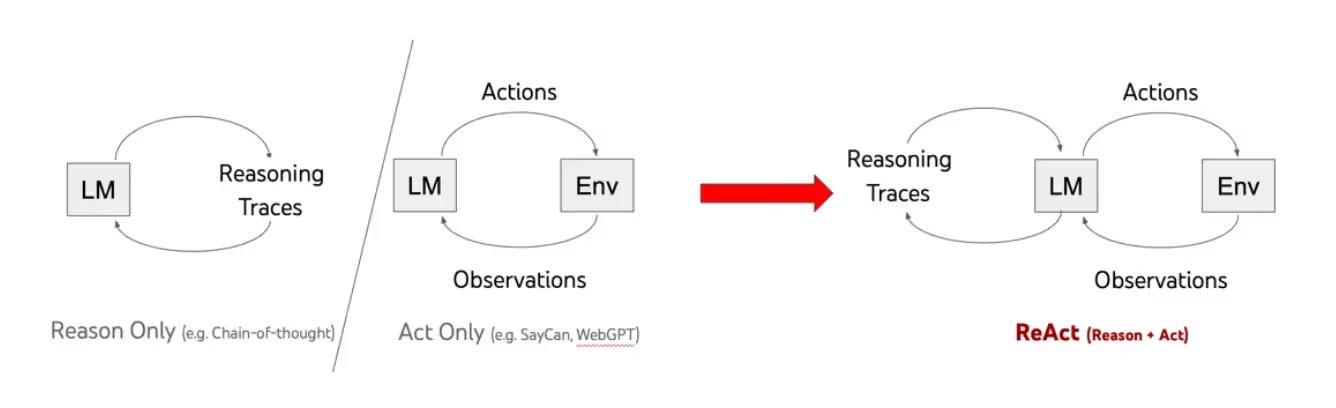
Originally proposed in a joint paper by Princeton University and Google, ReAct introduces a method that fuses two core capabilities of LLMs:
- Reasoning, often achieved through techniques like chain-of-thought prompting
- Acting, which involves generating and executing action plans (e.g., calling tools, retrieving data)
By combining these, LLMs are no longer just passive generators of text. They become agents capable of making decisions, interacting with environments, and refining their process as they work toward solving a task.
In practical terms, ReAct allows LLMs to structure and execute a sequence of operations — pulling in external data, making calculations, and iterating until a meaningful, actionable output is reached. It’s a game-changer in how we approach task automation.
LangChain ReAct: From Theory to Practice
At BigHub, we’re leveraging LangChain ReAct, one of the most accessible and powerful implementations of the ReAct paradigm. LangChain wraps the reasoning and acting logic into agent executors, enabling models to think step-by-step and interact with tools dynamically.
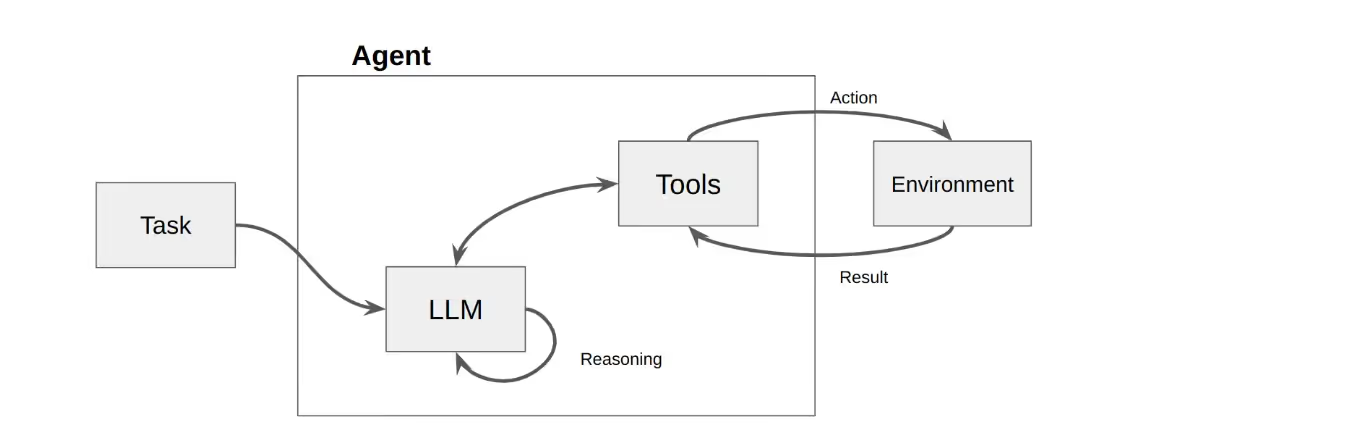
Let’s break it down with a fun — but technically accurate — example:
> Entering new AgentExecutor chain...
  Query: "Find Leo DiCaprio's girlfriend and calculate her age raised to 0.43 power."
  Action: Search
  Action Input: "Leo DiCaprio girlfriend"
  Observation: Camila Morrone
  Thought: "Need to find Camila Morrone's age"
  Action: Search
  Action Input: "Camila Morrone's age"
  Observation: 25 years
  Thought: "Need to calculate 25 raised to the 0.43 power"
  Action: Calculator
  Action Input: 25^0.43
  Observation: Answer: 3.991298452658078
  Thought: "I now have the final answer"
  Final Answer: Camila Morrone is Leo DiCaprio's girlfriend and her current age raised to the 0.43 power is 3.991298452658078.
> Finished chain.
This illustrates the model's ability to reason, act, and deliver a final answer — without human intervention between steps.
Why It Matters for Business
While the example above is playful, the business implications are profound. Take the insurance industry:
A LangChain ReAct-powered assistant could autonomously:
- Retrieve calculation formulas from internal knowledge bases
- Prompt users for missing inputs
- Perform real-time computations
- Deliver final results instantly
No hand-coded flows. No rigid scripts. Just dynamic, responsive, and intelligent interactions.
From automating customer service workflows to enabling deep analytical queries across datasets, ReAct opens the door to use cases across industries — finance, healthcare, logistics, legal, and beyond.
Elevate your AI game with LangChain: BigHub’s favorite new framework
LangChain: A Framework Built for the Future
LangChain is an open-source, modular framework designed to help developers harness the power of Large Language Models (LLMs). With support for multiple programming languages like Python and JavaScript, it's a flexible and accessible solution for building AI-driven apps that understand context, reason through problems, and act accordingly.
From the moment we first experimented with it, we saw how LangChain goes far beyond simple prompt-response applications. It enables agent-based systems — intelligent workflows that use reasoning, tool calling, and memory to accomplish complex tasks.
Why We Love It: Modularity, Integration, and Customization
Three things make LangChain stand out for us at BigHub:
- Ease of Integration – Plug it into existing systems quickly.
- Modular Design – Use only what you need, nothing more.
- High Customizability – Tailor it to fit specific business cases without rebuilding your stack.
LangChain’s structure allows businesses to evolve their AI capabilities without needing massive overhauls — ideal in today’s fast-moving tech environment.
Agents, Toolkits, and Use Cases
LangChain gives you the blueprint to build agents — smart components that combine reasoning with action. These agents can:
- Summarize documents
- Search databases
- Act as co-pilots in business workflows
- Power intelligent chatbots
- Answer complex queries with real-time data
Whatever the use case, LangChain's toolkit makes it easier to go from concept to prototype to production.
From Input to Insight: How LangChain Works
LangChain isn't just code — it’s a logical flow that mirrors human reasoning. Think of it like a dynamic flowchart, where each node represents a cognitive step: understanding the query, fetching relevant data, generating a prompt, and finally, crafting a response.
Here’s a simplified LangChain expression to illustrate this:
chain = (
    {
        "query_text": itemgetter("query_text"),
        "chat_history": itemgetter("chat_history"),
        "sources": {
            "chat_history": itemgetter("chat_history")
        }
        | RunnableLambda(lambda x: create_prompt(x["chat_history"]))
        | model_2
        | RunnableLambda(search_azure_cognitive_search),
    }
    | RunnableLambda(lambda x: create_template_from_messages(x["chat_history"]))
    | model
)
This isn’t just syntax — it’s a story. A structured process that makes AI responses more relevant, informed, and conversational.

BigHub recognized as a Microsoft Fabric Featured Partner
We've always focused on leveraging the latest technologies to deliver top-notch solutions. From the start, one of our most important partnerships has been with a tech leader in cloud and AI – Microsoft. This year has been full of exciting updates, from becoming a Microsoft Managed Partner to achieving the latest Fabric Featured Partner status.
What is Microsoft Fabric?
Earlier this year, Microsoft unveiled Microsoft Fabric in public preview – an exciting end-to-end analytics solution that combines Azure Data Factory, Azure Synapse Analytics, and Power BI. This all-in-one analytics powerhouse features seven core workloads seamlessly integrated into a single architecture, enhancing data governance with Microsoft Purview, simplifying data management with OneLake, and empowering users through Microsoft 365 integration. With advanced AI features like Copilot, Fabric boosts productivity and offers partners opportunities to create innovative, value-driven solutions, making data environments more secure, compliant, and cost-effective.
Being a Fabric Featured Partner means we’re skilled in using Fabric and ready to guide our clients through its implementation. Our team has undergone extensive training and with many clients where Fabric is already running, we can provide top-notch support and insights.
What this means for our customers
Microsoft Fabric is a comprehensive data platform designed to streamline your organization's data processes. By unifying various data operations, it significantly reduces the costs associated with operating, integrating, managing, and securing your data.
- Stay ahead with cutting-edge tech: Partnering with BigHub, you can access advanced features and updates that will keep your solutions state-of-the-art.
- Better support: Our close relationship with Microsoft, and access to their experts and resources, enables us to resolve even the trickiest issues quickly and solve everything correctly.
- Boosted productivity with AI: Using Fabric helps both our customers and our team to enhance productivity, and enjoy significantly faster data access and time-to-delivery.
8 years in the game: BigHub’s journey from startup to key player in applied AI
Back in 2016, two friends, Karel Šimánek and Tomáš Hubínek, decided to take a different path. They were passionate about artificial intelligence long before it became trendy, and despite everyone advising them against it, they stuck to their vision. The result? BigHub—a company specializing in advanced data solutions born out of their determination to do things their way.
Clients that trust us
Our unique journey and perseverance were recognized first abroad, with first clients from Germany, and the US, thanks to our cooperation with GoodData. But our domestic market quickly matured and we started to work for enterprise clients in Czechia and Slovakia. The first clients were mainly and quite surprisingly from the energy sector, ČEZ, E.ON, PPAS, and VSE. But we always saw the potential of AI technology for transforming every business. Our goal has always been to make AI accessible for all kinds of businesses, big or small.
While large enterprise clients are still our primary clientele, thanks to the enormous growth of opportunities that came with GPT, we've been opening up to small and medium-sized businesses too. Our GPT-based solutions offer clients better access to data analytics, powerful automation of back-office processes, and upgrade of their services - for a fraction of the price it would cost 8 years ago.
Wide recognition of our expertise
We’ve had some incredible milestones along the way, which helped BigHub to be recognized as a leader in applied AI. In 2021, BigHub ranked among the top ten fastest-growing tech companies in Central Europe in the prestigious Deloitte Technology Fast 50 CE ranking. Not bad for a company that started with just a few friends and a lot of ambition!
BigHub became widely recognized in 2023 when we won the Readers' Choice Award for the best business story in the EY Entrepreneur of the Year competition. Apart from the successes in awards, we gained recognition in prestigious outlets like Forbes, Hospodářské noviny, CzechCrunch, and EURO.cz.
Both of our founders have shared their expertise on major platforms like CNN Prima NEWS, where they provided valuable tips on spotting and protecting against deepfake and how to spot them, and in a series of interviews for Roklen24, where Karel Šimánek and Tomáš Hubínek discussed their insights on AI and the evolving digital landscape.
Our story shows how following your vision pays off, even when nobody else on the market sees it through.
Business growth
We built the BigHub on a strong team, friendly culture, and meaningful work. These foundations have helped us to grow sustainably over the years, growing approximately 20+ percent each year. This year, we’ll reach the big milestone of CZK 100 million in revenue.
We’ve evolved from offering custom-tailored projects to scalable products that still allow for client customization. It’s about finding that sweet spot between prefabricated solutions and personalized service, like automating insurance claim processes to save time for our clients.
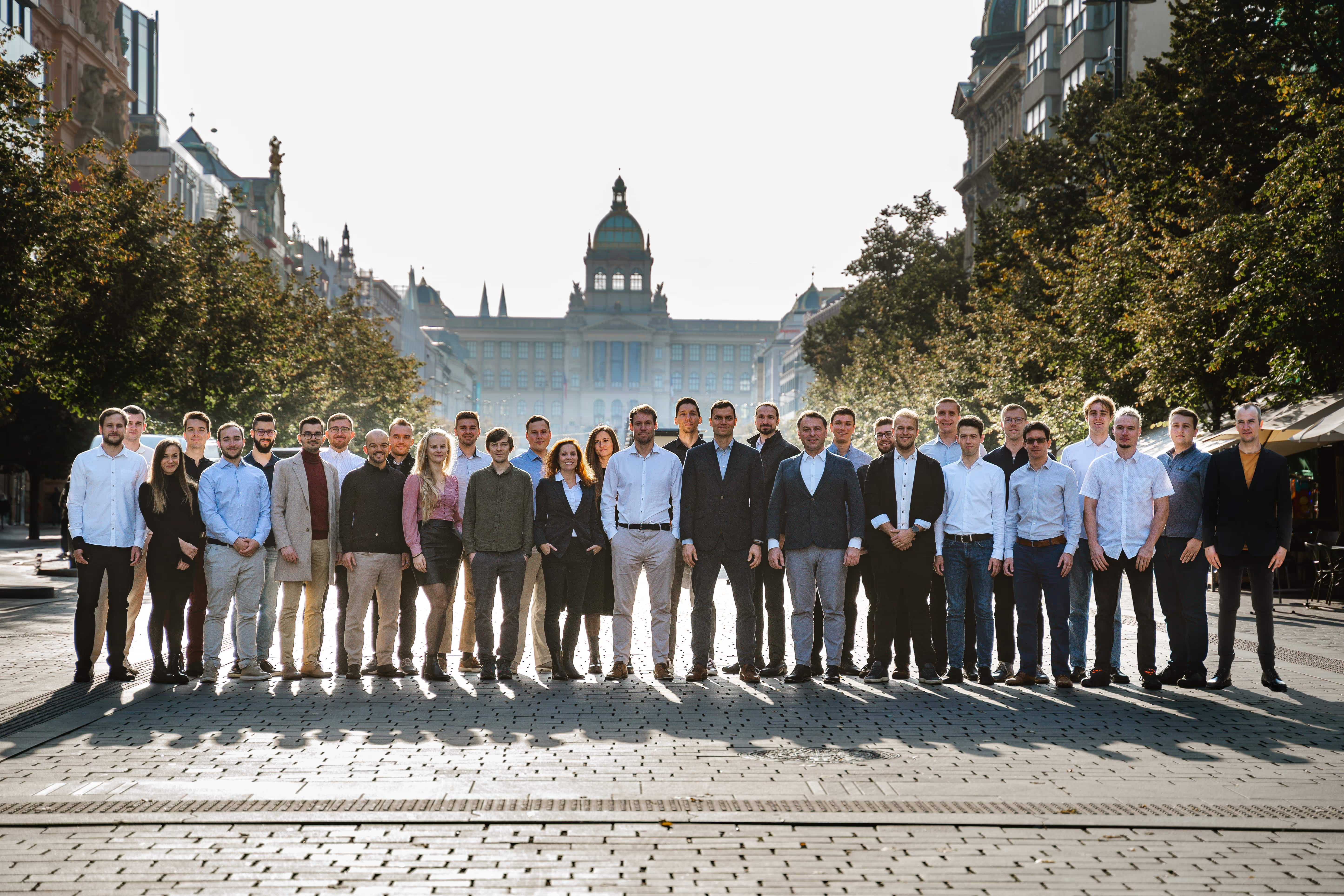
Our growth is based on the smart and motivated people we have the privilege to work with daily. Our team now consists of 46 amazing individuals. Whether it’s football matches, cycling trips, or summer parties, we succeeded in building and maintaining a culture that turns colleagues into lifelong friends.
We’ve always believed that education is key to staying ahead in such a fast-moving industry. That's why we not only work hard for our clients but also focus on our development. We regularly host internal workshops and hackathons, where our team can learn new upcoming technologies as well as come up with fresh ideas and innovative applications.
Acknowledged Partners
None of this would be possible without the support of our great partners. Microsoft has been a key technology vendor for many of our enterprise clients, and our partnership with them continues to thrive as our business grows. With time our partnership deepened and we are proud to gain multiple statuses - Microsoft Managed Partner, Microsoft Solution Partner for Data & AI on Azure, or the latest Fabric Featured Partner, to name but a few.
As our client base has expanded, we’ve become technology agnostic, working seamlessly with all the major platforms and gaining their partnerships as well, including AWS, Google Cloud, and Databricks. These partnerships are just another proof of our team's hard work and their never-ending will to learn. At the same time, proficiency in all the major technologies helps us to pick and deliver the very best solutions to our clients.
Giving back
Our connection to CTU – our alma mater – remains strong. For the past three years, we’ve been teaching a course on Applied Data Analysis, and this year we’re excited to launch a new follow-up course on Big Data tools and architecture. We sponsor student activities and provide both financial and non-financial support to initiatives like the Hlávka Foundation. We’re proud to say that our commitment to giving back remains unwavering. Whether it’s supporting the Data Talk community as a proud partner of the Data Mesh meetup for all the data enthusiasts out there, teaching, or mentoring students, we’re always looking for ways to inspire and contribute to the next generation of tech talent.
BigHub beyond the big puddle
This year we are strengthening our US presence! It represents a significant step forward in expanding our global reach, with a dedicated sales representative starting in October 2023 and multiple US clients already on board. It’s a bold move, and we couldn’t be more proud of the incredible team that made it happen. This is a big step for us in sharing our AI and data expertise with the largest market in the world!
As we look ahead, we’re more excited than ever for what the future holds and the new opportunities to innovate, grow, and give back. Our journey just started, and what a ride it has been so far!

BigHack: Turning real challenges into AI solutions
Pushing Boundaries with Generative AI
Artificial intelligence has always been in our DNA. Long before ChatGPT made headlines, we were using early GPT models for tasks like analyzing customer reviews. But the new wave of generative models has fundamentally changed what's possible. To keep up with — and get ahead of — this rapidly evolving space, we launched an internal initiative: BigHack, a hands-on hackathon focused on generative AI and its real-world applications.
We didn’t want to experiment in a vacuum. Instead, we chose real client challenges, making sure our teams were tackling scenarios that reflect the current business environment. The goal? Accelerate learning, build practical experience, and surface innovative AI-powered solutions for tangible problems.
Secure and Scalable: Choosing the Right Platform
One key consideration was how to work with these models in a secure and scalable way. While OpenAI’s public services have sparked mainstream adoption, they come with serious concerns around data privacy and usage. Many corporations have responded by banning them entirely.
That’s why we opted for Microsoft’s Azure OpenAI Service. It allows us to leverage the same powerful models while ensuring enterprise-grade data governance. With Azure, all data remains within the client’s control and is not used for model training. Plus, setting up the infrastructure was faster than ever — minutes instead of days compared to older on-prem solutions.
From Ideas to Prototypes: Two Real Projects
We selected two project ideas from a larger pool of discussions and got to work. With full team involvement and the power of the cloud, we built two working prototypes that could easily transition into production.
1. “Ask Your Data” App
This application enables business users to query analytical data using natural language, removing the dependency on data analysts for routine questions like:
- “What’s our churn rate?”
- “Where can we cut IT costs?”
By connecting directly to existing data sources, the app delivers answers in seconds, democratizing access to insights.
2. Intelligent Internal Knowledge Access
Our second prototype tackled unstructured internal documentation — especially regulatory and policy content. We built a system that allows employees to ask free-form questions and get accurate responses from dense, often chaotic documentation.
This solution is built on two key pillars:
- Automated Reporting: Eliminates the need for complex dashboard setups by using AI to interpret well-governed data and generate reports based on simple queries.
- Regulatory Q&A: Helps users instantly find information buried in hundreds of pages of internal compliance or legal documents.


Get your first consultation free
Want to discuss the details with us? Fill out the short form below. We’ll get in touch shortly to schedule your free, no-obligation consultation.