



The organizations getting the most from AI are not the ones with better models. They are the ones with better data foundations.
It is worth being honest about how far the model has slid down the list of things that matter. The latest language and embedding models are available to everyone at roughly the same quality, and standing up an impressive demo takes days. The demo is easy. The system behind it is not. What separates a proof of concept from something an enterprise can trust is almost never the model. It is whether the data underneath it can be used again and again, safely and consistently.
Across more than 500 projects with over 100 enterprise clients since 2016, the same warning signs come up again and again. They fall into three groups: whether the data itself can be trusted, whether the architecture can serve it, and whether AI can work safely on your knowledge. Here are the ten that matter most, and what to actually do about each.
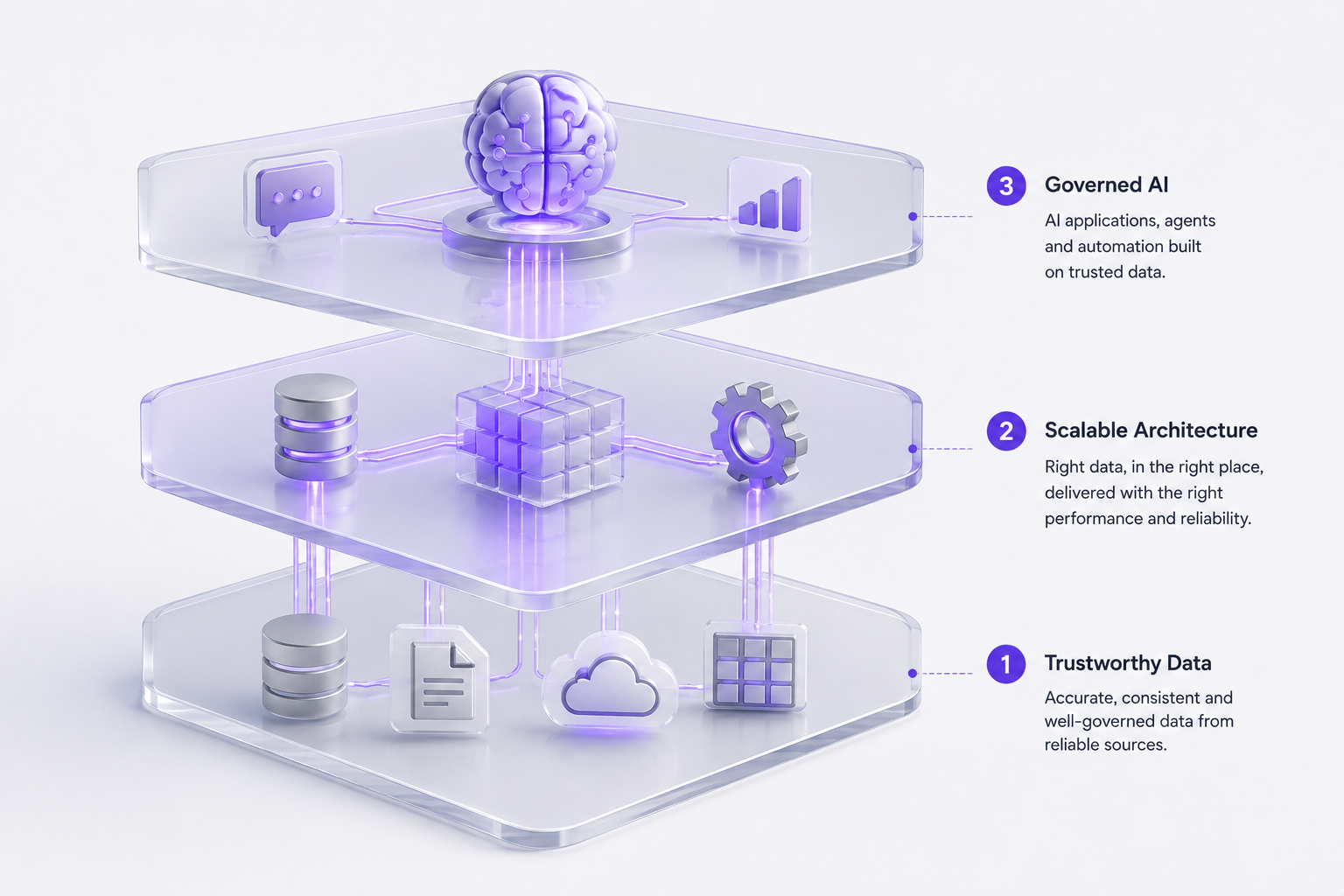
Trust in the numbers comes first
Before architecture, before models, a simpler question. Do people in your organization trust the numbers they already have? Often the answer is no, and AI makes that gap obvious fast.
1. The same KPI means different things to different teams
Ask three departments for last month’s revenue and you may get three figures. Finance counts invoiced sales net of VAT, sales counts booked orders, a dashboard reports a third number. For years this was survivable, because a person in the room knew which version to trust. An AI assistant has no such instinct. It quotes whichever definition it was pointed at. The first time a leader sees two contradictory answers, trust in the whole system is gone.
The fix is less technical than it sounds. Agree, once, on a single definition for each critical metric. Give it an owner. Treat any change as a deliberate, communicated decision, not a private edit. A shared language for your top KPIs lets AI settle an argument instead of starting one.
What we see in practice
Organizations often believe they have a data quality problem.
In reality, they have a consistency problem.
The data exists. The business simply disagrees on what it means.
2. Data is produced as reports, not as products
In many companies, data still arrives the old way. Someone asks a question, an analyst pulls an export, cleans it by hand, sends it on. The next question starts over. No single report is wrong, but none is reusable, and two analysts can answer the same question with two different numbers and no one accountable for the gap.
Treating data as a product changes how the organization relates to it. A critical dataset stops being prepared on demand and becomes a service: a named owner, defined quality and freshness, a clear definition, a plan to improve it. That is not process for its own sake. It is how an AI system relies on the same data tomorrow that it used today.
3. When data breaks, nobody finds out in time
Most data does not fail loudly. A feed lands late, a load runs half-empty, a field changes shape, and the dashboard shows a number as if nothing happened. In a reporting world, someone eventually catches it. In an AI world, the broken data is already inside an answer to a customer. Reporting forgives a late feed. AI does not.
The instinct is to monitor everything. Resist it. Start with the datasets that feed your first AI use cases, and watch the three failures that actually happen: data that arrives late, volumes that swing far from normal, structures that change without warning. Give each alert an owner and a simple response. Monitoring everything creates noise. Monitoring what your AI depends on creates trust. It is the daily reality behind why clean data matters.
Even with trustworthy data, the architecture gets in the way
Plenty of organizations fix their definitions and still stall. AI brings a workload their systems were never built for. BI explains what happened. AI increasingly decides what happens next, and it needs to know what is happening right now. That single shift exposes architectural limits most companies have never had to solve.
What we see in practice
Companies rarely rebuild their architecture because of AI.
More often, AI just exposes bottlenecks that were always there.
The architecture was never wrong. It was built for a different question.
4. Everything still runs through one monolithic warehouse
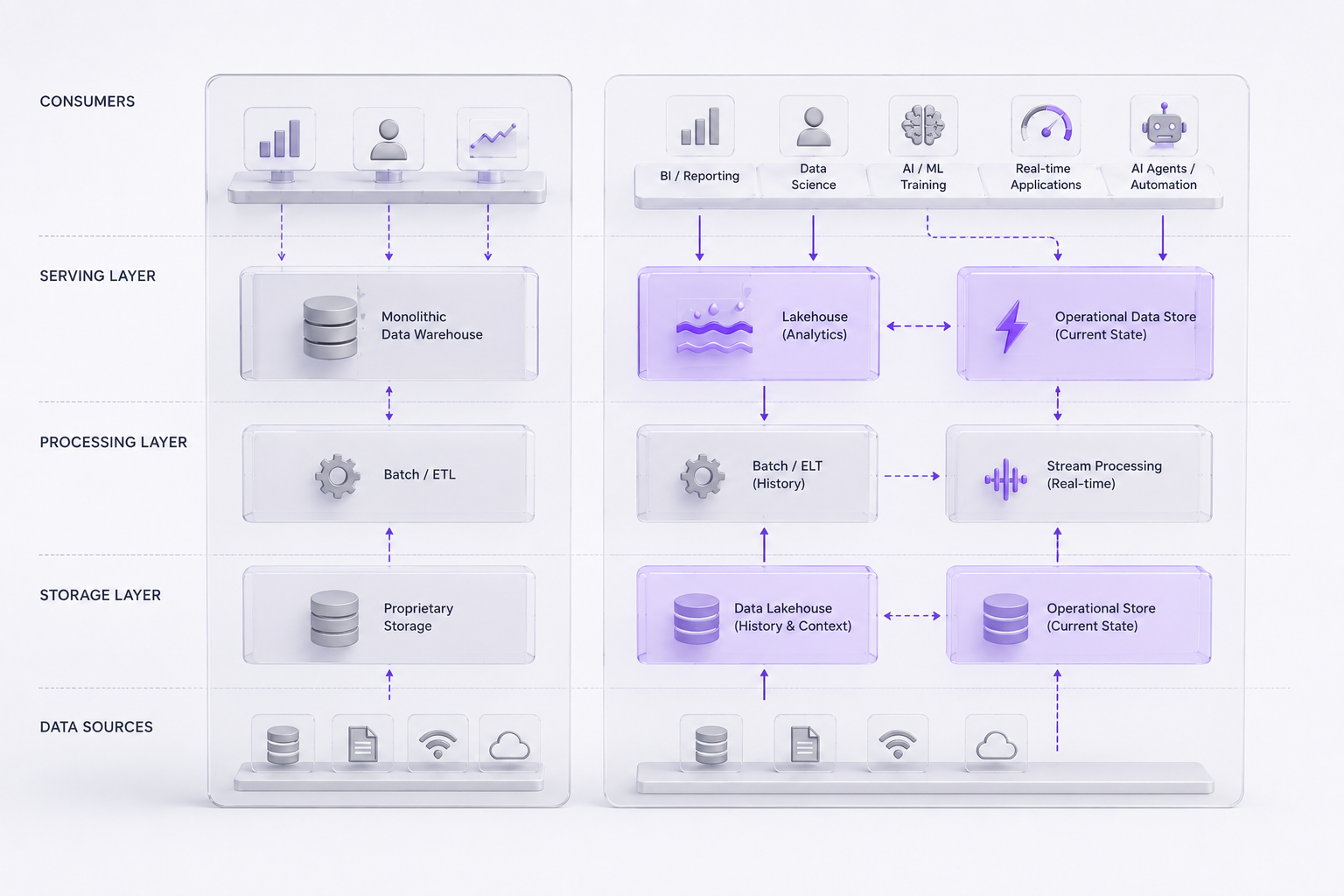
A warehouse is excellent for yesterday. AI increasingly cares about now. Built for batch processing, historical aggregates, and SQL analytics, a single warehouse strains the moment you ask it for low-latency, operational queries: storage priced for performance even on cold data, an awkward fit for events and unstructured content, and a change process so interconnected that one adjustment ripples through dozens of reports. Everything runs at one speed, and that speed is rarely now.
The answer is not another migration project. Different workloads have different requirements, and historical analytics should not compete with operational AI for the same architecture. Data has a temperature. Cold and hot history, analytics, and model training belong in a lakehouse; warm, current-state data belongs in a faster operational layer built for it. Separate the two and you stop paying to scale one expensive system for workloads that never belonged together.
5. AI has to reach into your core systems to know what is happening now
Enterprise AI earns its keep the moment it answers operational questions. A warehouse manager asks which orders are blocked by missing inventory. A claims adjuster asks which cases need manual review today. Finance asks whether an invoice has already been paid.
That is the moment many organizations discover their architecture was never designed to hand out operational data safely. The only way to answer is to query the ERP, the CRM, or SAP directly, which is slow, costly, and risky enough that most IT teams refuse. Rightly.
This is what an operational data store, an ODS, is for. It sits between the core systems and everything that consumes them, fed through your integration layer, holding only the current state that matters. It answers live questions fast, takes load off the systems the business runs on, and keeps a clean line between warm operational data and colder history in the lakehouse. Do not build it for everything. Pick three to five high-value questions and start there.
What we see in practice
The blocker is rarely technical.
No one has ever had to expose operational data outside the core system, so there is no safe path to do it.
The ODS is an organizational decision as much as an architectural one.
6. Real-time turns out to mean nothing in particular
Almost every enterprise says it has real-time data. Press a little, and the term dissolves. To one team it means a copy of the core systems within minutes; to another, an hourly stream aggregation; to a third, an event feed with a seconds-level guarantee. Often the real-time layer exists on paper, but events flow with no clear path, no validation, and no one watching whether they arrive. For AI the effect is small but expensive. The system reacts late, and a technically correct answer can already be wrong by the time it lands.
Start with a definition, not a technology. Once each use case has an agreed meaning of real-time, the minimum is unglamorous and reliable: a clear flow from source to consumer, basic validation, monitoring that confirms data arrived on time and in full, and an owner who reacts when it does not. You know it works when a delay is caught before it reaches a customer, not after.
7. The API was built for one app, and it shows
An API is often an accident of history, a by-product of the first web or mobile app that needed one. It works until you connect something new: an AI agent, a partner, another team. Then it shows its age. Brittle, unversioned, every change breaks another consumer, and onboarding anything new becomes a project. That friction is the real line between a pilot and scaling.
The shift is simple: stop treating the API as plumbing for one application and start treating it as a product. Stable. Versioned. Governed. Built around business capabilities rather than individual channels. Give AI a stable interface to current, well-defined data, and the workarounds and manual glue that sink so many AI projects stop appearing.
What we see in practice
AI projects rarely fail because an API is missing.
They fail because every API was built around a different application.
The fix is rarely more APIs. It is fewer, better ones.
Once AI touches your documents, discipline matters more than models
Structured data is only half the story. The most valuable enterprise AI increasingly works over documents: policies, contracts, procedures, product knowledge. Here the gap between a demo and a dependable system is almost entirely about discipline.
8. AI answers from your documents, but no one can say which one
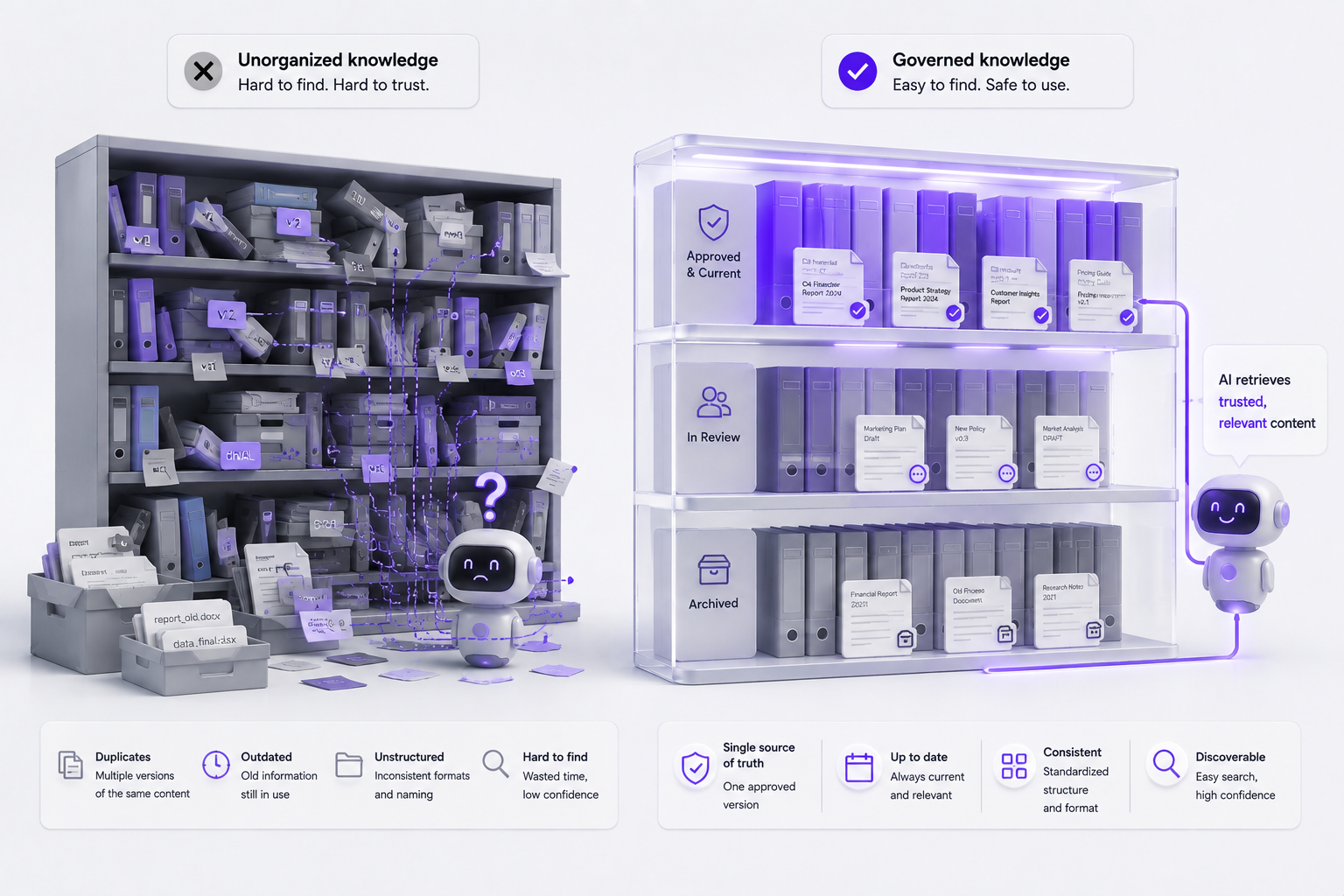
An assistant gives a confident, fluent answer about an HR policy or a contract clause. It sounds right. But nobody can tell which document it used, or whether that document is still valid. In our experience the real risk is almost never the model. It is the underlying content: outdated files, no clear source of truth, no owner. An AI system will give a correct answer from the wrong document, and trust drains fast when it does.
Safe AI over company knowledge comes down to a few principles: draw only from approved sources, give each source an owner, respect the reader’s access rights, keep to the current version, and cite the passages behind every answer. Technically, that is retrieval-grounded generation: approved documents live in a document store with a vector index, the system retrieves the most relevant passages, and every answer carries its evidence. It is the same discipline as good enterprise search. It turns a plausible answer into a defensible one.
What we see in practice
The hardest part of document AI is rarely the retrieval.
It is discovering how much of the source of truth is outdated, duplicated, or owned by no one.
AI does not create that problem. It just makes it impossible to ignore.
9. Nobody actually knows if the AI’s answers are any good
Ask most teams how their AI is performing and you get an impression, not a measurement. That is how a system slips: the off-topic answer, the one with no source, the one that leaks something sensitive, unnoticed until a customer or auditor notices first. It seems fine is not a control.
Measuring quality is simpler than it looks. Assemble twenty to fifty real questions from actual use, and score each answer on three things: is it relevant, is it grounded in a source, is it within the user’s permissions. Re-run the set whenever you change the sources or the process. Watch a few production signals too: how often the AI escalates to a human, how often it finds no answer, how many answers carry citations. The goal is not a perfect score. It is a decision you can defend, scale this, adjust this, or stop this, made on evidence rather than instinct.
10. The AI belongs to everyone, and therefore to no one
The last sign decides whether the others get solved. When an AI use case has no owner and every scenario gets the same reflex, you land in one of two failure modes: too cautious to ship, or too casual to be safe. The same assistant can be harmless summarizing an internal FAQ and real trouble drafting something a customer acts on. Most organizations treat both the same.
Governance, done well, is not bureaucracy. It is what lets AI scale without fear. The practical version is modest: give every use case an owner, classify it by risk, match the controls to the risk. Low-risk uses run automatically with a record of what happened. Higher-risk ones earn a human check, restricted sources, and an escalation path. Under that sit five basics: an owner, approved sources, access rules, an audit trail, an incident process. There is now a regulatory reason to have them, with EU AI Act penalties reaching up to 7 percent of global annual turnover. The point is not to slow AI down. It is to make it defensible enough to speed up.
Conclusion
The foundation is the strategy. These do not look like ten separate problems. They are symptoms of the same one: can your organization trust its own data enough to build on it, again and again, without starting over each time. The pattern holds from the first sign to the last. AI did not create these gaps. It exposed them, the moment something began to depend on them.
The conversation around enterprise AI still starts with models. In the organizations that succeed, it starts with data. Large language models get more accessible every month. Trusted enterprise data does not.
AI has become remarkably easy to build. Trusted enterprise AI has not. The difference is not the model, the framework, or the cloud platform. It is whether the organization has built a data foundation that AI can rely on, repeatedly, safely, and at scale. That is what being AI-ready really means.

.avif)